
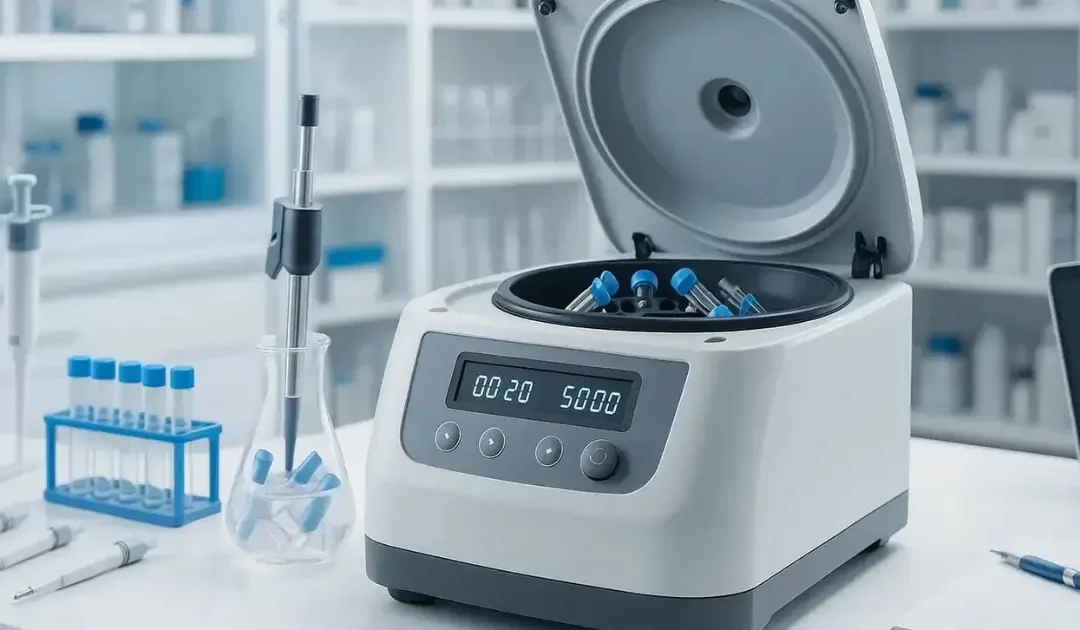
If you are selecting a centrifuge for a clinical lab, you are making a decision that will affect the quality of every diagnostic result processed on that instrument. Clinical centrifugation is not just about spinning tubes quickly. It is about separating blood components with the right force, the right rotor geometry, and the right safety profile to produce clean, consistent results that clinicians can rely on. The wrong choice creates problems that are not always immediately visible, but that show up over time as inconsistent separations, compromised samples, and unreliable downstream test results.
Choosing the right laboratory centrifuge for clinical use means working through a clear set of requirements based on your protocols, your daily sample volume, and your lab’s specific tube formats. This guide walks through every factor that matters.
Start With RCF, Not RPM
The single most important variable in clinical centrifuge selection is the relative centrifugal force (RCF) your instrument can generate, not the RPM. This distinction matters because two centrifuges running at the same RPM can generate very different forces depending on their rotor radius. A longer rotor arm generates more centrifugal force at the same rotational speed than a shorter one.
RCF is expressed in units of xg (times gravity) and represents the actual force applied to your sample. Clinical diagnostic protocols specify centrifugation conditions in RCF because it is a consistent, rotor-independent measure that produces reproducible separation results regardless of what instrument is used. For most routine clinical blood processing, effective RCF ranges fall between 1,000 and 3,000 xg for serum and plasma separation, and above 3,000 xg for pelleting red blood cells in applications like hematocrit determination. Always confirm your SOPs specify RCF, and verify the centrifuge and rotor combination can achieve those values before purchasing.
Understand the Two Main Rotor Types
Fixed-angle rotors hold tubes at a constant angle, typically between 25 and 45 degrees from vertical, throughout the spin. Heavier particles pellet against the side and bottom of the tube as they travel outward along the tube wall. This design reaches set speed quickly, generates strong pelleting forces, and is appropriate for compact blood tube formats and applications where a defined pellet rather than a clean interface is the priority.
Swing-out (swinging-bucket) rotors start with tubes held vertically and swing to a horizontal position as the rotor reaches speed. This geometry means particles travel the full length of the tube and settle at the bottom, producing well-defined, horizontal interfaces between plasma, buffy coat, and red cells. For clinical diagnostic labs focused on serum or plasma harvesting from vacutainer tubes, swing-out rotors produce cleaner layer separation and are the preferred clinical choice.
Selecting the rotor type depends on your primary separation goal. Serum and plasma harvesting for chemistry panels swing-out. General pelleting or microcentrifuge work fixed-angle. Some benchtop clinical centrifuges accommodate interchangeable rotors, which gives you the flexibility to use both in one instrument.
Match Tube Format to Rotor Capacity
One of the most common centrifuge buying mistakes is selecting a model based on published speed specifications without verifying that it can actually run your tube formats at your working batch size. Before purchasing any centrifuge for clinical use, list your most frequently used tube types: standard vacutainer tubes (5 mL to 10 mL), 15 mL conicals, 1.5 mL microtubes, hematocrit capillary tubes, and any urine sediment tubes.
Verify that the rotor or rotors available for your chosen centrifuge accommodate all of these formats, either natively or with adapters. Count how many tubes you need to run per batch during your busiest period and confirm the rotor capacity can handle that load without requiring multiple runs back to back. Throughput efficiency in a clinical lab depends as much on per-run capacity as on spin time.
Prioritize Safety Features for Clinical Environments
A laboratory centrifuge for clinical use operates in an environment where biological samples are a daily exposure risk. Safety features are not optional extras. The minimum acceptable safety profile for a clinical centrifuge includes: an electric lid lock that prevents the instrument from operating unless the lid is fully closed and locked; automatic lid release after the rotor has come to a complete stop; an imbalance detection system that halts the run if sample distribution is uneven; and an overspeed detection system that shuts down operation if the rotor exceeds its rated maximum speed.
Conformity with IVD (In Vitro Diagnostic) medical equipment standards under EN61010-2-101 is also essential for clinical diagnostic labs. Look for CE, cTUVus, and FCC certification marks, which confirm the instrument has been independently tested for safety and performance in diagnostic environments.
Consider Motor Type and Noise Level
Clinical centrifuges run continuously throughout the working day, often in shared or semi-open laboratory environments. Brushless DC motors are the preferred motor type for clinical settings because they require no maintenance, run quieter than brush motors, generate less heat during extended use, and have significantly longer service lives. A clinical centrifuge with a brushless motor and noise levels at or below 56 decibels operates in the background without creating disruption, which matters in labs where multiple instruments are running simultaneously.
A Clinical Centrifuge Built for Diagnostic Demands
The DM0412 Clinical Centrifuge from NE LabSystems is purpose-designed for this environment. It runs at 300 to 4,500 RPM with speed displayable in both RPM and G-force, accommodating standard serum separation and urine protocols with equal reliability. The brushless DC motor runs quietly and maintenance-free. The electric lid lock with automatic release protects operators between runs. Timed operation from 30 seconds to 99 minutes begins counting only once the set speed is reached, ensuring your separation time matches your protocol exactly. It meets IVD standards under EN61010-2-101:2002 with CE, cTUVus, and FCC certifications, making it a compliant and dependable choice for clinical diagnostic settings.
Evaluate Throughput and Total Cost of Ownership
Beyond the purchase price, evaluate how long each run cycle takes, including acceleration and braking time, how many samples you can process per hour under realistic clinical load, and what the service and maintenance requirements look like over the expected instrument life. A laboratory centrifuge for clinical use that requires frequent rotor replacement or experiences high downtime creates operational costs that far exceed any initial savings on the purchase price.
At NE LabSystems, every centrifuge we carry comes backed by free extended warranties on U.S. purchases and support from factory-trained engineers who understand clinical lab demands. Browse the full centrifuge catalog online or call (877) 733-6838 to get a recommendation matched to your specific clinical workflow and tube formats.