
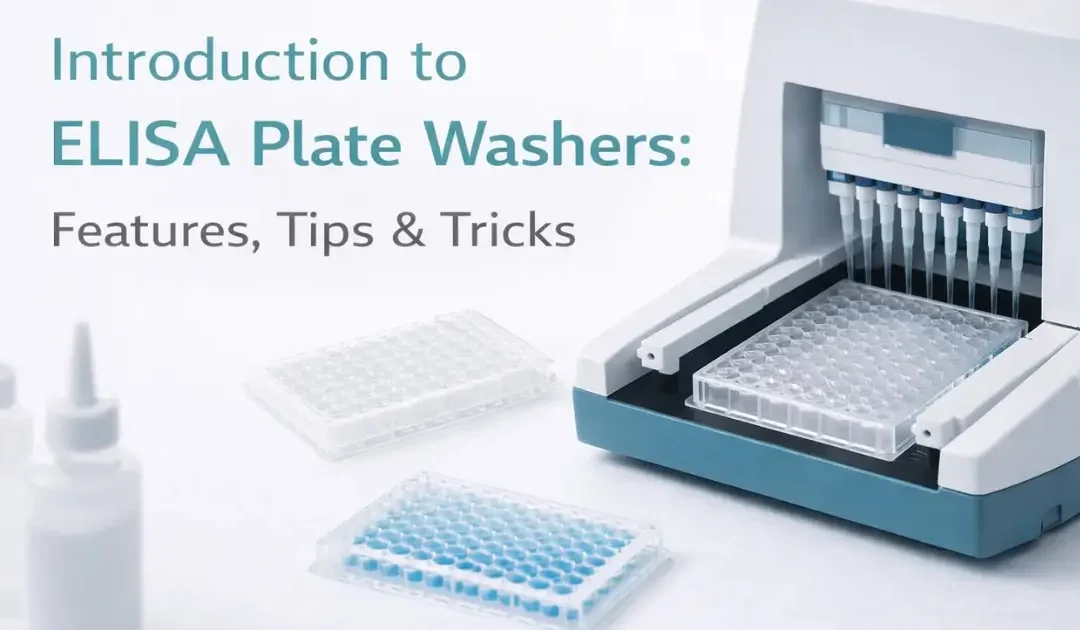
If you have run enough ELISA assays to start recognizing patterns in your results, you have probably noticed something: the plates that produce clean, consistent standard curves are not necessarily the ones where you used the freshest reagents or the most carefully prepared samples. They are the plates where the washing was done correctly. The wash step in ELISA is not a background process. It is one of the most technically consequential steps in the entire assay, and how it is performed has a direct, measurable effect on your background signal, your sensitivity, and your reproducibility.
The microplate washer exists to remove that variability from the equation entirely. By automating the dispense, soak, and aspiration steps with controlled parameters and consistent timing, it transforms the wash step from the weakest link in your ELISA workflow into one of its most reliable. This guide explains exactly how, why, and where microplate washers matter most in ELISA testing.
Why the Wash Step Is Critical in ELISA
ELISA (Enzyme-Linked Immunosorbent Assay) is an antibody-based immunoassay that detects and quantifies specific proteins or antigens in a sample by measuring a colorimetric or fluorescent signal from an enzyme-linked detection system. The assay relies on selective binding of target molecules to capture antibodies immobilized on the plate surface. Everything else, including unbound sample components, non-specifically adsorbed proteins, excess detection antibodies, and unbound enzyme conjugates, must be removed before the final signal measurement.
That removal happens entirely during the wash steps. If unbound material remains in the wells, it contributes to background optical density that elevates your blank readings, compresses your standard curve, reduces your signal-to-noise ratio, and lowers the sensitivity of the assay. This is why ELISA performance is considered the benchmark by which a microplate washer is judged.
According to industry performance standards, automated microplate washers achieve a coefficient of variation (CV) below 3% per well and less than 4% CV across a full plate, leaving residual volumes under 2 microliters per well. Manual washing with a squeeze bottle or manifold cannot approach these values consistently across multiple plates.
The Three Core Functions of a Microplate Washer in ELISA
Dispense
The washer delivers a controlled volume of wash buffer to each well simultaneously or in rapid sequence. Volume control matters because insufficient buffer fails to dilute unbound material effectively, while excessive volume can disturb the bound antibody layer. Standard ELISA wash volumes range from 200 to 300 microliters per well for a 96-well plate.
Soak
A programmed soak period allows the wash buffer to interact with unbound material in the well before aspiration. Soak times are typically 30 to 60 seconds per wash cycle for standard ELISAs. Longer soak times improve unbound material removal but extend total assay time.
Aspirate
The washer removes liquid from each well down to a defined residual volume. The aspiration height, which is the distance between the aspiration probe tip and the well bottom, must be carefully calibrated. Too high and residual volume is excessive; too low and the probe risks disturbing the capture antibody layer. Premium washers use cross-wise aspiration from multiple points per well to minimize residual volume while maintaining bound layer integrity.
Key Microplate Washer Uses Beyond Standard ELISA
Sandwich ELISA
The most common ELISA format involves a capture antibody bound to the plate, a target antigen from the sample, a detection antibody, and an enzyme-linked secondary antibody. Each of these binding events is followed by a wash step that removes excess unbound material before the next addition. The washer performs all of these wash steps with identical parameters, ensuring that the reduction in background is consistent across all wells and all plates in the run.
Competitive ELISA and inhibition assays
These formats often involve more complex reagent interactions where residual unbound material can produce signals that obscure the competitive inhibition curve. Precise, reproducible washing is critical to assay sensitivity in these formats.
Multiplex immunoassays
Multi-analyte formats using bead-based capture systems require especially careful washing to prevent bead loss during aspiration. Automated washers with programmable aspiration speed and head position allow slower, gentler aspiration settings that protect bead-based assays while still achieving thorough removal of unbound material.
Cell-based assays
Some cell-binding and receptor assays use microplate formats where living cells are adhered to the plate surface. Washing in these applications requires angled or low-velocity aspiration to prevent cell detachment. Specialized wash heads designed for cell-based applications allow the same washer to serve both standard ELISA and cell-based protocols.
Programmable Parameters That Make the Difference
The most important feature of any microplate washer used for ELISA is the ability to independently program every wash parameter and save those parameters as a named protocol. This means setting the wash volume per well, number of wash cycles, soak time, aspiration speed, aspiration height, and whether to include a shaking step during soak. Protocols saved by name eliminate manual re-entry before each run, ensuring that every operator runs every plate under exactly the same conditions.
Protocol memory is also essential for labs running multiple assay types. A lab running a standard cytokine ELISA alongside a hormone immunoassay and a cell-binding assay on the same instrument needs three distinct saved protocols, each matched to the specific requirements of that format. Without protocol memory, parameter entry errors become a source of inter-run variability that cannot be distinguished from biological variability in the data.
The Stat Fax 2600: Built for Consistent ELISA Washing
The Programmable Stat Fax 2600 Microplate/Microstrip Washer from NE LabSystems is designed for exactly this kind of programmable, consistent ELISA washing. It supports mix, soak, and timing functions that remain constant regardless of run size, with aspiration position optimized per well type and double aspiration for complete liquid removal. The software adjusts automatically for different plasticware formats, reducing setup time when switching between plate types. For clinical and research labs that need dependable, reproducible ELISA washing at scale, it delivers the wash performance that assay accuracy depends on.
Microplate Washer Uses Summary: Why Automation Matters
The microplate washer’s role in ELISA testing is not to replace skilled laboratory technique. It is to eliminate the single most variable manual step in a technically sensitive assay and replace it with a precisely controlled, documented, repeatable process. For labs running ELISAs regularly, the investment in automated washing directly translates to lower background, higher sensitivity, better run-to-run reproducibility, and fewer failed assay runs.
Browse the full microplate washer range at NE LabSystems or call (877) 733-6838 to discuss which model fits your ELISA throughput and assay complexity.