
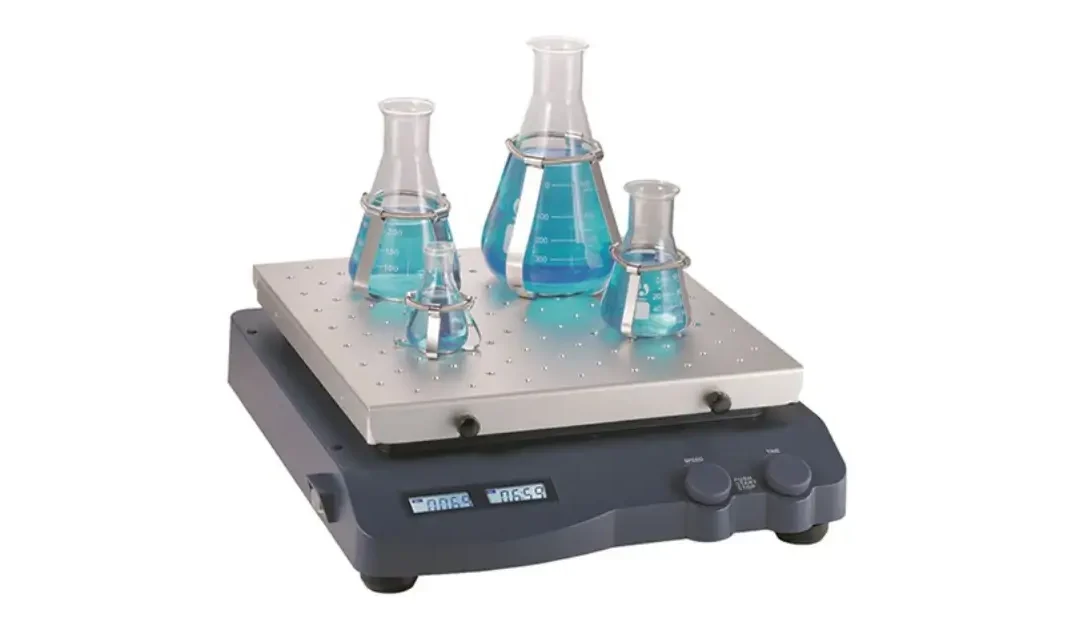
The laboratory orbital shaker is one of the most versatile instruments in scientific research, appearing on benches in microbiology labs, molecular biology departments, pharmaceutical development facilities, and clinical research environments in equal measure. Its core function is simple: it moves a platform in a smooth, horizontal circular path, creating orbital motion that mixes, aerates, and uniformly agitates samples in flasks, tubes, dishes, and plates. But that simple function serves an extraordinary breadth of applications.
This guide explains how orbital shakers work, the types available for different laboratory settings, the speed ranges appropriate for different applications, and how to choose the right model for your workflow.
The Orbital Motion Principle And Why It Matters
An orbital shaker generates horizontal circular motion through an eccentric motor mount that moves the entire platform in a circle of defined diameter (the orbital diameter) at a controlled speed. This motion creates a gentle swirling in liquid samples that simultaneously achieves two outcomes: mixing of the liquid contents and, for open or vented vessels, increased gas transfer at the liquid surface. The oxygen transfer rate (OTR) produced by orbital motion is the key factor for aerobic biological applications and is directly affected by both speed and orbital diameter.
Fisher Scientific’s orbital shaker selection documentation confirms that orbital shaker speed directly affects oxygen transfer rate and therefore cell culture growth. Smaller orbit diameters (19 to 25 mm) allow higher maximum speeds, typically 400 to 500 RPM; larger orbits (50 mm) have lower maximum speeds around 300 RPM. The orbital diameter is a fixed hardware parameter for each instrument model, so selecting the right orbit for your application is part of the initial selection decision.
Types Of Laboratory Orbital Shakers
Benchtop orbital shakers are the standard form factor, designed for room temperature operation or placement in incubators or cold rooms. They offer larger platforms, higher weight capacities, and straightforward loading. They are the practical first choice for labs running bacterial culture, protein expression, solubility studies, and general mixing at ambient or incubated temperatures.
Incubator-compatible orbital shakers are designed specifically to operate inside CO2 incubators or standard incubators. They feature corrosion-resistant materials for high-humidity environments, compact footprints to fit within incubator chambers, and motors rated for sustained operation at elevated temperatures. They are indispensable for mammalian cell suspension culture and any application requiring both temperature control and agitation simultaneously.
Refrigerated orbital shaker incubators combine orbital shaking with active cooling capability, allowing operation down to 4 degrees Celsius. Protein expression protocols that benefit from lower temperatures to improve soluble yield are the primary application, along with cold-room-equivalent culture experiments that do not have access to a dedicated refrigerated environment.
Speed Ranges For Key Applications
Selecting the correct laboratory orbital shaker speed for your specific application significantly affects your results.
Bacterial culture: 200 to 250 RPM in Erlenmeyer flasks on a standard orbit maintains adequate dissolved oxygen for aerobic organisms. Fill volumes should not exceed 20 to 25 percent of flask capacity to maintain the headspace needed for gas exchange.
Mammalian cell suspension culture: 30 to 100 RPM provides the gentle mixing needed to prevent cell settling without generating shear stress that damages the plasma membrane.
Protein expression: 120 to 200 RPM, often at reduced temperatures of 16 to 25 degrees Celsius, balances adequate oxygenation with the slower growth conditions that produce more soluble recombinant protein.
ELISA and plate-based assays: 50 to 100 RPM provides gentle coverage for microplate incubation without washing solution off the plate.
Gel staining and blotting: 15 to 70 RPM delivers gentle surface coverage for flat-surface applications where the goal is uniform reagent contact rather than suspension mixing.
The Scilogex Sci-O180-Pro: A Versatile Orbital Shaker
The SCILOGEX SCI-O180-Pro Orbital LCD Digital Shaker from NE LabSystems covers 100 to 800 RPM with a brushless DC motor, dual LCD displays for speed and timer, cold room and incubator compatibility, PC control via RS232, and a 2-year warranty. Its 10 mm orbital action and 2.5 kg load capacity serve the full application range from bacterial culture to ELISA plate incubation. Browse the orbital shaker range at NE LabSystems or call (877) 733-6838 for a recommendation matched to your application.