
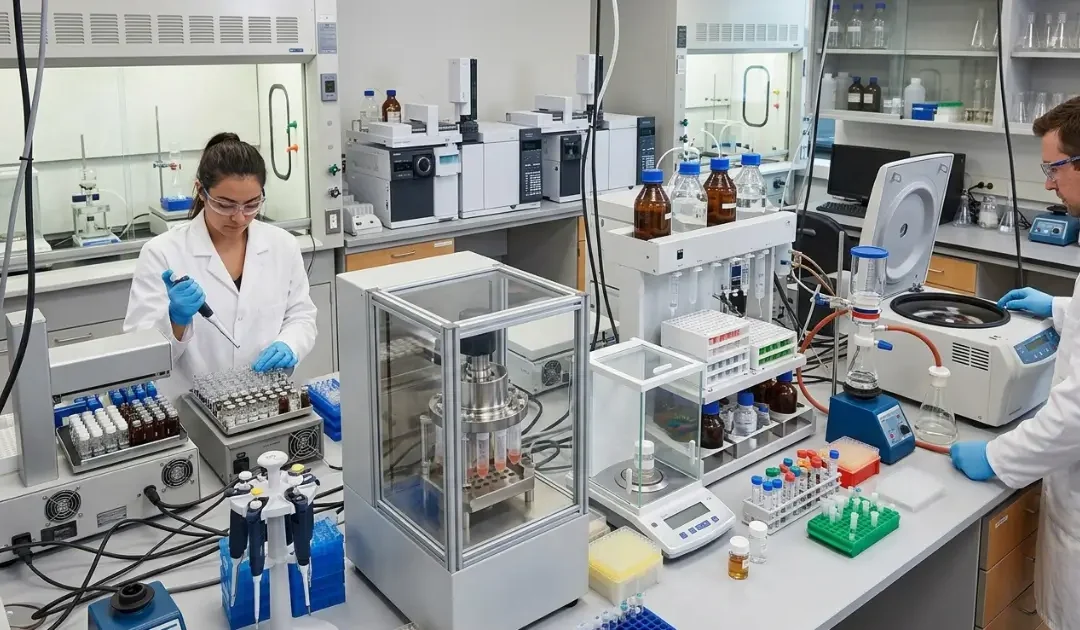
Every laboratory instrument represents a potential hazard in addition to a scientific tool. Centrifuges generate high rotational forces that can cause catastrophic rotor failure if improperly loaded. Water baths and heating blocks present burn and electrical risks. Biological samples processed in clinical labs carry infection exposure risks. Chemical reagents create fume, splash, and flammability hazards. Laboratory equipment safety practices are the structured measures that allow laboratory work to proceed productively while controlling these risks to acceptable levels.
This guide covers the foundational safety practices for laboratory equipment, from regulatory requirements and PPE selection to instrument-specific hazard controls.
The Regulatory Framework: OSHA and Institutional Requirements
The primary regulatory framework for laboratory equipment safety in the United States is OSHA’s Laboratory Standard, 29 CFR 1910.1450, which applies to any employer engaged in laboratory use of hazardous chemicals. According to OSHA’s Laboratory Safety Guidance document, the standard requires that employers develop and implement a Chemical Hygiene Plan, train workers on hazardous chemical handling and emergency procedures, and provide appropriate PPE to protect against chemical, biological, and physical hazards at no cost to employees. These requirements establish the minimum baseline for laboratory equipment safety practices; institutional policies, accreditation requirements, and specific risk assessments add additional requirements on top of this baseline.
Personal Protective Equipment (PPE): The First Line of Defense
PPE is required in laboratories because engineering controls and administrative measures cannot eliminate all exposure risk. OSHA mandates that laboratories provide appropriate PPE, including gloves, goggles, and lab coats, to protect workers from chemical, biological, and physical hazards. According to Cornell University’s EHS laboratory safety documentation, laboratory personnel must assess the hazards of specific operations to determine what additional PPE is necessary, with relevant factors including the materials being used, their concentration and quantity, the hazards they present, and the potential routes of exposure.
Nitrile gloves are the standard for most biological and chemical work, providing protection against biological pathogens, many common solvents, and chemical reagents. Safety goggles or safety glasses protect against splashes from reagents and biological fluids. Lab coats protect skin and street clothing from chemical and biological contamination. Face shields provide full-face protection for operations with significant splash risk.
Centrifuge Safety Practices
Centrifuges receive specific safety attention in OSHA’s laboratory guidance because high-speed rotor failures can cause significant injury. Key safety practices include: always inspect the rotor for cracks, corrosion, or deformation before each use and remove any damaged rotor from service immediately; balance the load symmetrically before each run to prevent the vibration and rotor stress caused by asymmetric loads; never open the lid during a run or attempt to manually stop the rotor; and use safety centrifuge cups with sealed lids when processing potentially infectious samples to contain aerosols in the event of tube breakage.
Heating Equipment Safety
Water baths and dry bath incubators present burn risks from contact with heated surfaces and vessels. Water baths also present electrical hazards if water contacts electrical components or if the instrument is used with cracked or damaged vessels. Key safety practices include: using insulated gloves when removing vessels from heated baths; ensuring water does not contact electrical connections; never heating sealed vessels in a water bath or dry bath where internal pressure buildup could cause explosive opening; and verifying that heating blocks are rated for the temperature being used before loading samples.
Biological Safety in Clinical Laboratories
Clinical laboratory work involves regular contact with blood, urine, and other patient specimens that may contain bloodborne pathogens. OSHA’s Bloodborne Pathogens Standard (29 CFR 1910.1030) requires clinical laboratories to implement universal precautions for all patient specimens, use engineering controls including biosafety cabinets and safety centrifuge cups, provide hepatitis B vaccination to at-risk workers, and train workers on bloodborne pathogen exposure risk and post-exposure procedures.
Emergency Preparedness
OSHA requires emergency equipment including eyewash stations, safety showers, fire extinguishers, and first aid kits to be present in laboratory spaces and readily accessible from any working position. Eyewash stations must be reachable within 10 seconds of any potential exposure location, per ANSI Z358.1 requirements. Lab personnel must be trained on the location and use of all emergency equipment before working in the laboratory. This training requirement is explicitly included in laboratory equipment safety practices documentation from OSHA and institutional biosafety programs.
Building a Safety Culture
Effective laboratory equipment safety practices are not just about compliance documentation. They require a laboratory culture where safety is integrated into every workflow decision: where proper PPE use is the default behavior rather than an imposed requirement, where hazard assessments precede the introduction of any new procedure or chemical, and where safety concerns are raised and addressed without hesitation.
At NE LabSystems, we carry laboratory instruments that meet international safety standards including CE, cTUVus, FCC, and IVD certifications, all backed by free extended warranties on U.S. purchases. Browse the full laboratory instrument catalog at NE LabSystems or call (877) 733-6838 for guidance on selecting safe, compliant instruments for your laboratory.