
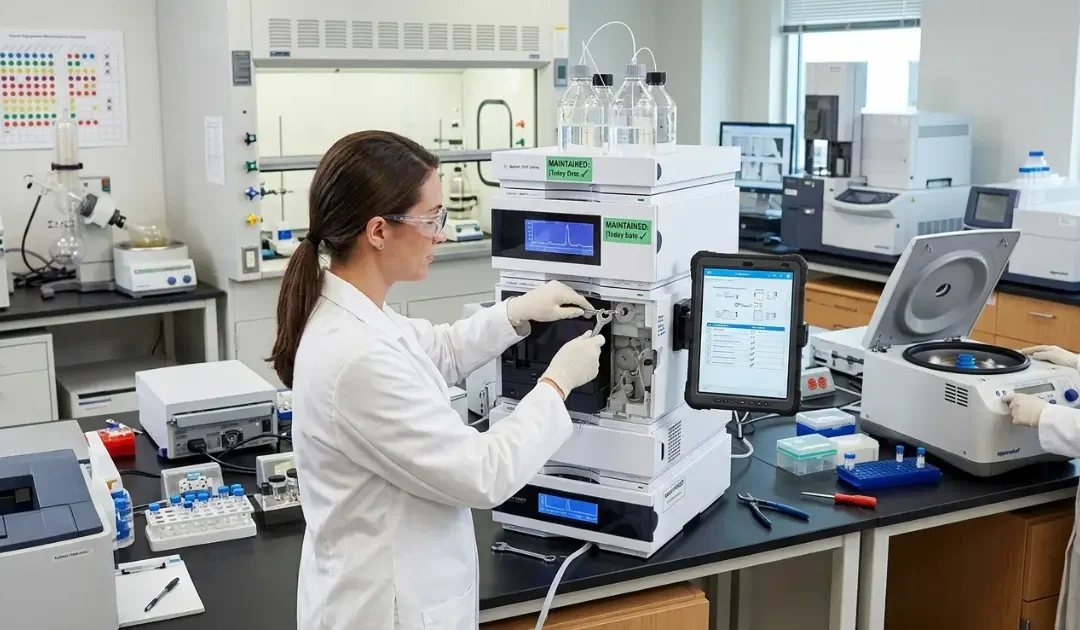
A study by Frost and Sullivan found that laboratory managers rank instrument maintenance and downtime as their top operational concern. The consequences of unplanned equipment downtime in a laboratory setting reach well beyond the instrument itself: samples collected during the failed run may be unusable, patient results are delayed, research timelines slip, and the cost of emergency service typically exceeds the cost of the repair that would have prevented the failure. Laboratory equipment downtime is not just an inconvenience. It is a quantifiable cost to laboratory productivity, quality, and credibility.
The good news is that most unplanned downtime is preventable. This guide covers the strategies that consistently reduce unplanned instrument failures and keep laboratory operations running.
Preventive Maintenance: The Foundation of Uptime
Reducing laboratory equipment downtime starts with replacing reactive, corrective maintenance with proactive, preventive maintenance. According to Crello Health’s laboratory maintenance documentation, preventive maintenance is the most effective strategy to eliminate the likelihood of potential equipment breakdowns, malfunctions, or lengthy repairs. A preventive maintenance program that schedules regular cleaning, inspection, calibration verification, and part replacement keeps instruments in optimal condition and catches developing problems before they produce failures.
The key principle is that maintenance is performed on a schedule, not only when problems become visible. Scheduled maintenance creates predictable, planned downtime of minutes to hours rather than unplanned downtime of hours to days. Planned maintenance can be scheduled around workflow peaks. Unplanned failures cannot.
Usage-Based Maintenance: Aligning Schedule to Actual Wear
Standard time-interval preventive maintenance (monthly, quarterly, annually) does not account for differences in how intensively individual instruments are used. An instrument running 16 hours per day accumulates wear much faster than one running 4 hours per day, yet a time-interval PM schedule treats both identically. According to Lab Manager’s maintenance documentation, usage-based maintenance involves monitoring and measuring the usage and performance of individual instruments so that maintenance is aligned with actual wear and tear rather than fixed calendar intervals.
Tracking sample volume, run counts, or operating hours for each instrument provides the data needed to adjust maintenance frequency to actual workload. High-use instruments receive more frequent preventive attention; low-use instruments are not over-maintained unnecessarily.
Predictive Maintenance: Catching Problems Before They Fail
Predictive maintenance extends beyond preventive maintenance by using real-time performance data to identify developing problems before they produce failures. According to Lab Manager’s predictive maintenance research, AI and sensor-based predictive maintenance approaches can meaningfully reduce unexpected device downtime and extend equipment lifecycle when the underlying data infrastructure is sound. Sensors monitoring temperature stability, motor current draw, vibration, and speed accuracy can detect abnormal patterns that indicate developing mechanical issues, motor wear, or calibration drift before any functional failure occurs.
For most laboratory settings, a practical implementation of predictive maintenance starts with tracking performance metrics during routine calibration checks: does the centrifuge reach its set speed consistently? Does the water bath return to set point within the expected time after door opening? Trends in these metrics identify equipment heading toward failure well before the failure occurs.
Spare Parts Inventory Management
Extended downtime is often caused not by the failure itself but by the time required to obtain replacement parts. A centrifuge that fails due to a bearing failure requires the bearing to be ordered, shipped, and installed before it can return to service. If that bearing is in stock in a local service parts inventory, repair time is measured in hours. If it must be ordered, repair time is measured in days. Lab Manager’s downtime reduction documentation specifically identifies streamlining maintenance, repair, and operations inventory as a key step in reducing downtime, noting that extended downtime often results from missing or inadequate MRO supplies.
Equipment Redundancy for Critical Instruments
For instruments that are critical path for patient care or high-priority research, a backup instrument eliminates laboratory equipment downtime as a consequence of any single instrument failure. This is not always economically feasible, but for instruments like clinical centrifuges and analyzers that process patient specimens without which reporting is impossible, the cost of a backup instrument may be justified by eliminating the operational and liability cost of extended reporting delays.
Partnering with Suppliers for Ongoing Support
Building a relationship with a supplier who provides responsive technical support, access to parts, and engineering expertise reduces the time to resolution when problems do occur. At NE LabSystems, we support the long-term performance of every instrument we sell through free extended warranties on U.S. purchases and factory-trained engineering support. Browse the full laboratory instrument catalog at NE LabSystems or call (877) 733-6838 to discuss how our support programs help labs minimize instrument downtime.