
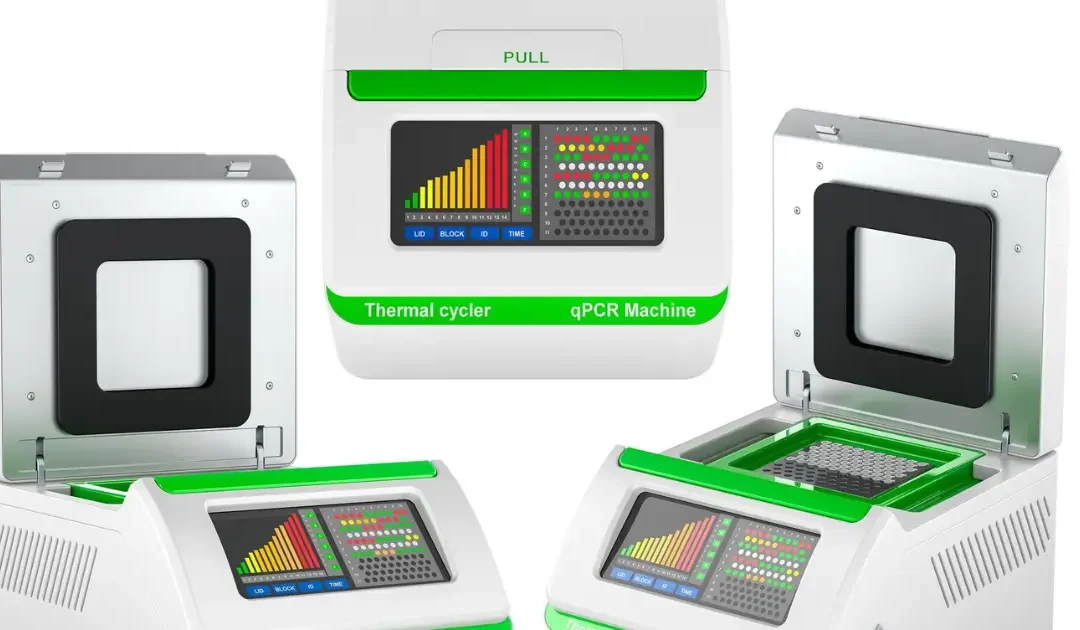
If you are evaluating PCR instruments for your lab and have encountered the choice between a standard thermal cycler and a gradient thermal cycler, you are dealing with a decision that is worth understanding properly before committing either way. Both instruments automate the temperature cycling that makes PCR possible. Both use Peltier element technology to heat and cool a metal block holding your samples. Both produce amplified DNA from a template. The difference between them is in what you can do with the annealing step, and that difference has significant implications for assay development efficiency and PCR optimization quality.
This guide explains exactly what separates these two instrument types, when each one is the right choice, and what to look for if your lab needs the optimization flexibility of gradient capability.
How a Standard Thermal Cycler Works
A standard thermal cycler runs every position on its sample block through the same temperature program simultaneously. When you set an annealing temperature of 58 degrees Celsius, every tube in every well on the block reaches 58 degrees Celsius during that step. The program runs: denaturation at 94 to 98 degrees Celsius to separate the double-stranded DNA template; annealing at the target temperature where primers bind; and extension at 72 degrees Celsius where DNA polymerase synthesizes new strands. This three-step cycle repeats 25 to 40 times, producing millions of copies of the target sequence.
Standard thermal cyclers are reliable, consistent, and appropriate for any lab running validated protocols with established primer sets and known optimal annealing temperatures. Once a protocol is optimized, a standard cycler runs it reproducibly day after day without requiring any modification. For clinical diagnostic labs running fixed, validated assays, for teaching labs running established educational protocols, and for any application where protocol optimization is not a regular activity, a standard thermal cycler is the right instrument.
How a Gradient Thermal Cycler Differs
A gradient thermal cycler adds one critical capability: it can apply a temperature gradient across the sample block during the annealing step, so different columns or rows of wells simultaneously experience different temperatures within a defined range. The user sets a low temperature and a high temperature for the gradient span, and the cycler calculates and maintains precise temperatures for each column across the block.
In a 96-well format, this typically produces 12 distinct annealing temperatures tested simultaneously in a single run. The same reagents, the same template, the same polymerase, and the same cycle conditions run in parallel at 12 different annealing temperatures. When you analyze the gel result from this single run, you identify which column or columns produced the cleanest, most specific amplification at the highest yield. That temperature becomes your validated annealing temperature for the protocol.
The gradient function works through Peltier elements positioned at opposite ends of the sample block, creating a controlled temperature differential across its length. Precision thermal sensing technology ensures that the temperature at each block position is stable and reproducible, which is essential for drawing meaningful conclusions from gradient optimization experiments.
The Critical Role of Annealing Temperature Optimization
The annealing temperature is the most sensitive variable in PCR design. Too low, and primers bind non-specifically to off-target sequences, producing additional bands that complicate interpretation and can mask or overwhelm your target amplicon. Too high, and primer binding efficiency drops, reducing amplification yield. The optimal temperature maximizes both specificity and yield simultaneously, and it cannot be reliably predicted from melting temperature calculations alone. It must be determined empirically.
According to Thermo Fisher Scientific technical guidelines, gradient thermal cyclers enable simultaneous screening of a temperature range across the block, allowing labs to identify the optimal annealing temperature in a single experiment rather than through iterative single-temperature runs. Bio-Rad documentation similarly emphasizes that gradient optimization dramatically accelerates protocol development by collapsing what might take multiple days of separate experiments into a single day’s work.
Thermal Cycler vs. Gradient Thermal Cycler: Which Does Your Lab Need?
Choose a standard thermal cycler if
Your lab runs a defined set of validated protocols with established annealing temperatures; you do not regularly develop new assays or introduce new primer pairs; your primary use case is routine, validated PCR in a clinical or educational setting; and cost is a significant constraint.
Choose a gradient thermal cycler if
Your lab regularly develops new assays or works with new primer pairs that require annealing temperature optimization; you run multiplex PCR where multiple primer pairs need a shared compromise temperature; you work in molecular diagnostics where protocol validation is a formal requirement; or you troubleshoot existing protocols that have started producing inconsistent results and need to re-optimize conditions quickly.
For research labs, the gradient function is not a luxury. It is a time and reagent efficiency tool that pays for itself across every new assay developed on the instrument. For clinical labs running only validated diagnostic assays, a standard cycler with excellent block uniformity and ramp rate performance delivers everything needed without the additional cost of gradient capability.
What to Look for in a Gradient Thermal Cycler
Temperature uniformity
The gradient is only meaningful if each block position holds its assigned temperature accurately. Look for uniformity within plus or minus 0.2 degrees Celsius across all well positions.
Gradient span
A useful gradient spans 15 to 20 degrees Celsius. A wider span covers a greater optimization range per run.
Ramp rate
High ramp rates (4 to 5 degrees Celsius per second heating, 3 degrees per second cooling) keep run times manageable for labs running multiple optimization experiments per day.
Intuitive programming
Gradient protocols should be programmable and reviewable through a clear touchscreen interface that allows you to confirm the temperature at each block position before starting.
Explore the Right PCR Instrument for Your Lab
At NE LabSystems, our thermal cycler range includes both standard and gradient-capable models. The SCILOGEX SCI1000-G Gradient Thermal Cycler delivers high performance and high throughput with excellent temperature uniformity, high-speed ramp rates, and a color LCD touchscreen interface, compatible with 96 x 0.2 mL PCR tubes and standard 96-well plates. All models are backed by free extended warranties on U.S. purchases and factory-trained engineering support. Browse the full range online or call (877) 733-6838 to discuss which cycler fits your PCR workload.