
Every PCR protocol has one variable that determines more about the outcome than almost anything else: the annealing temperature. Get it right, and your primers bind with precision. Your target amplifies cleanly. Your gel shows a single, sharp band. Get it slightly wrong, and non-specific amplification creeps in. Your band intensity drops. Your results become inconsistent between runs.
The challenge is that the optimal annealing temperature is not something you can simply calculate from first principles and trust. It must be determined empirically, through actual testing. That is where gradient thermal cyclers change the game entirely. This guide explains why labs that prioritize PCR quality and efficiency are choosing gradient-capable instruments, and what those instruments actually do to improve your results.
What Is a Gradient Thermal Cycler?
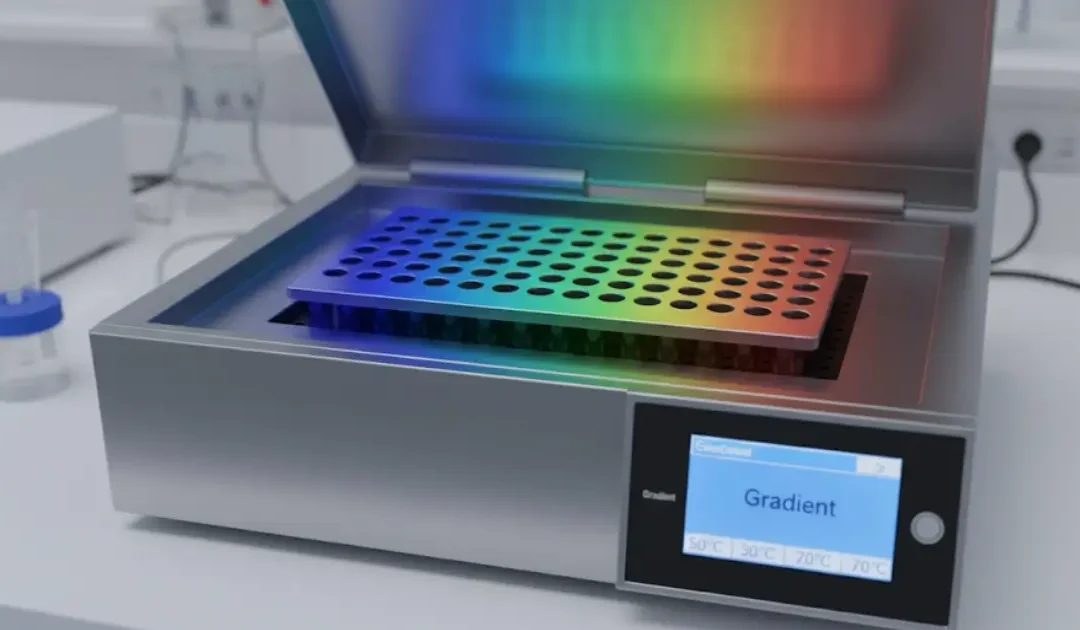
A standard thermal cycler heats every well on the block to the same temperature at each step. A gradient thermal cycler introduces a deliberate temperature difference across the block during the annealing step, so different columns of wells experience different temperatures within the same run.
The user sets a temperature range, specifying a lower limit and an upper limit, and the cycler calculates a distribution across the columns of the block. In a 96-well format, this typically means 12 columns each running at a slightly different annealing temperature spanning the full defined range. One run, twelve conditions, tested simultaneously with the same reagents, the same polymerase, and the same template preparation.
The operational principle relies on Peltier elements and precision thermal sensing technology. The cycler establishes and maintains a stable temperature differential across the block, ensuring that the differences observed in PCR performance are attributable to temperature alone and not to any other variable.
Why Use Gradient Thermal Cyclers: The Core Advantage
The answer is efficiency. Without a gradient function, finding the optimal annealing temperature requires you to set up and run a separate PCR reaction for each temperature you want to test. If you are testing a range of 10 degrees in one-degree increments, that is 10 separate experiments, each consuming reagents, disposables, and bench time.
With a gradient thermal cycler, all 10 conditions run simultaneously in a single experiment. The Bio-Rad technical literature notes that this approach dramatically accelerates the protocol development phase, compressing what might take multiple days of iterative testing into a single day’s work.
For labs that regularly develop new assays or work with new primer pairs, this efficiency translates directly into reduced reagent consumption, faster time to a validated protocol, and lower overall cost per assay development cycle.
Improved Specificity and Cleaner Results
The benefit of gradient thermal cyclers is not just speed. It is the quality of the endpoint you reach. When you identify the precise optimal annealing temperature for a primer pair, you maximize both the specificity and the yield of your reaction simultaneously.
Specificity means your primers bind only to the intended target sequence and not to other regions of the genome. Suboptimal annealing temperatures, particularly temperatures that are slightly too low, allow primers to bind at mismatched sites, producing non-specific bands that complicate your results and can mislead downstream analysis.
Yield is the total amount of amplified product. Annealing temperatures that are slightly too high cause primers to bind too stringently, reducing amplification efficiency and lowering product yield. Finding the exact temperature that maximizes both simultaneously is what gradient optimization achieves.
According to technical documentation from Analytik Jena, optimization using gradient thermal cyclers ensures that the observed changes in PCR performance are attributable solely to temperature, providing a reliable and reproducible thermal array that translates directly into protocol robustness.
Practical Applications Where Gradient Cyclers Deliver the Most Value
Gradient thermal cyclers are most valuable in the following scenarios.
- New assay development: Any time you are working with a new primer pair for the first time, gradient optimization should be the first step before committing the protocol to routine use.
- Multiplex PCR: When multiple primer pairs are running in the same reaction, each pair has a slightly different optimal annealing temperature. Gradient optimization helps identify a compromise temperature that works well for all primer pairs simultaneously.
- Genotyping applications: Allelic discrimination assays require tight temperature control to distinguish between wild-type and mutant sequences. Even a few degrees of deviation can collapse the discrimination between alleles, making gradient optimization critical to assay validity.
- Troubleshooting existing protocols: If a previously reliable protocol has started producing inconsistent results, running a gradient experiment around your current annealing temperature can quickly identify whether temperature drift or a change in reagent lot has shifted your optimal condition.
Gradient vs. Standard Cycler: Which Does Your Lab Need?
If your lab runs established, well-validated protocols with fixed primer sets and rarely introduces new assays, a standard thermal cycler with excellent block uniformity and ramp rate performance is a sensible and cost-effective choice.
If your lab develops new assays regularly, works in molecular diagnostics where protocol validation is a formal requirement, or runs a diversity of primer pairs across different applications, a gradient-capable cycler is not a luxury. It is the right tool for the job.
At NE LabSystems, our thermal cycler range includes gradient-capable models designed for exactly this kind of demanding molecular biology work. All come backed by free extended warranties for U.S. purchasers and full support from factory-trained engineers. Browse the full selection online or call (877) 733-6838 to discuss which model fits your lab’s PCR profile.