
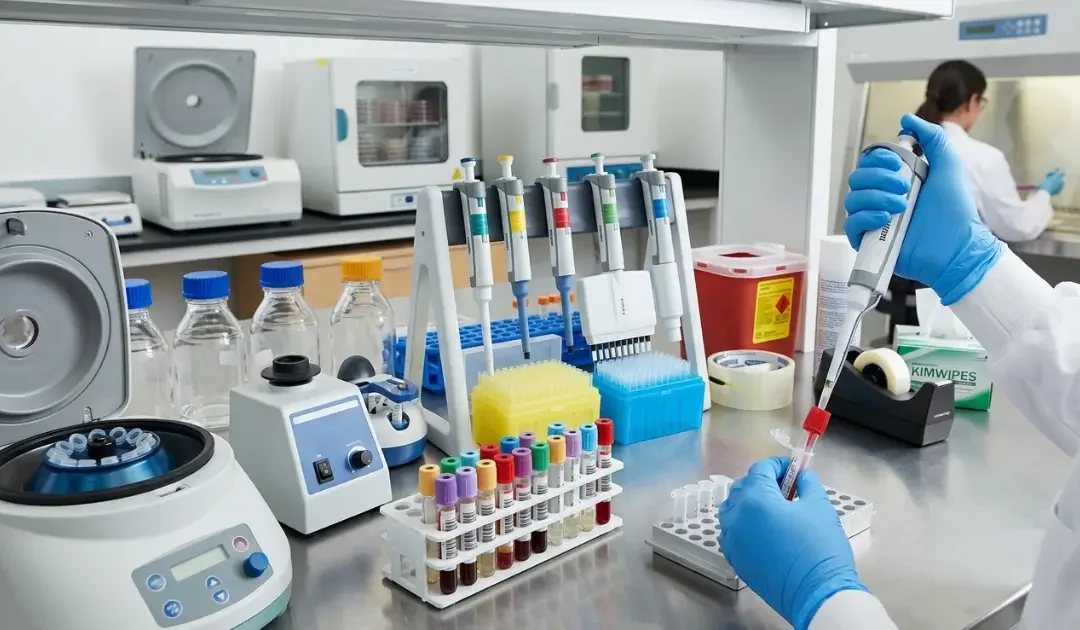
In clinical laboratory diagnostics, the validity of every patient result depends not just on the analytical instrument that produces the measurement, but on the preparation steps that convert a raw patient specimen into an analysis-ready sample. Sample preparation tools for clinical laboratories are the instruments that perform these preparation steps: separating blood components, mixing specimens to ensure homogeneity, heating samples for incubation-dependent assays, and removing particulate matter that would interfere with downstream analysis.
This guide covers the essential sample preparation tools that support accurate, reliable clinical diagnostic workflows.
Clinical Centrifuges: Blood Component Separation
The centrifuge is the most foundational piece of sample preparation equipment in clinical diagnostics. According to ScienceDirect’s bioanalysis review, the centrifuge is the most commonly used equipment in clinical research and practice for isolating cells and particles from liquid matrices during sample preparation. Clinical centrifuges operate at 300 to 4,500 RPM, generating the 1,000 to 3,000 xg required for serum and plasma separation from whole blood. The separated serum or plasma is the sample matrix for the vast majority of clinical chemistry tests.
Hematocrit centrifuges are a specialized clinical variant that spin capillary tubes at 10,000 to 12,000 RPM to determine packed cell volume (PCV), a key diagnostic value for anemia and dehydration assessment. Clinical centrifuge selection requires attention to rotor type (swing-out rotors produce cleaner plasma separations), tube format compatibility, and IVD compliance certification.
Vortex Mixers and Multi-Tube Vortex Systems
Clinical samples including urine, whole blood, and other biological specimens settle during transport and storage. Before aliquoting or analysis, these samples require thorough mixing to ensure that the sample loaded onto the analyzer is representative of the whole specimen. Vortex mixers provide rapid, vigorous mixing that achieves this in seconds per tube. For high-volume clinical labs processing batch sizes of 20 or more samples simultaneously, multi-tube vortex systems process all tubes at once, eliminating the time cost of sequential single-tube vortexing and ensuring that all samples are mixed for identical durations.
Dry Bath Incubators: Precise Temperature for Clinical Assays
Clinical chemistry protocols often require sample incubation at specific temperatures before analysis. Enzyme activity assays, coagulation studies, and serum protein tests all incorporate temperature-controlled incubation steps. Dry bath incubators, with their precise block temperature control within plus or minus 0.3 to 0.5 degrees Celsius and contamination-free heating environment, are the preferred sample preparation tools for clinical laboratories handling these incubation requirements. They accommodate standard vacutainer tube formats and provide rapid temperature equilibration for the small volumes used in clinical chemistry workflows.
Tube Rotators: Preventing Pre-Analytical Settling
Blood tubes collected in ethylenediaminetetraacetic acid (EDTA) anticoagulant for hematology testing must be gently and continuously mixed to prevent clotting and cellular sedimentation during the pre-analytical holding period before analysis. Tube rotators provide end-over-end rotation at 10 to 30 RPM that maintains blood homogeneity without the shear forces or hemolysis risk that vortexing would cause. This is a critical quality step for hematology samples where cellular count accuracy depends on uniform distribution of cells throughout the sample at the time of analysis.
Filtration Systems: Removing Particulate Interference
Clinical samples containing visible turbidity, fibrin clots, or cellular debris require filtration before loading onto automated analyzers that could be clogged or optically interfered with by particulate matter. Syringe filters with 0.2 or 0.45 micrometer membranes and spin column filters for small volumes remove these interferents efficiently. Urine samples for microscopy and culture require centrifugation and resuspension steps that prepare the cellular components for examination.
Microplate Washers: Cleaning Between Assay Steps
For clinical laboratories running ELISA-based diagnostic tests, the microplate washer is a critical sample preparation tool that removes unbound reagents between assay incubation steps. Automated washing with programmed dispense volumes, soak times, and aspiration ensures consistent, reproducible removal of non-specifically bound material that would otherwise elevate background and reduce assay specificity.
Matching Tools to Your Clinical Workflow
The sample preparation tools for clinical laboratories described above each serve a specific function in the chain from raw specimen to analysis-ready sample. The specific combination your lab needs depends on the test menu you run, the sample types you receive, and the analyzers you use downstream.
At NE LabSystems, we supply clinical centrifuges, vortex mixers, dry bath incubators, tube rotators, and microplate washers all suited to clinical diagnostic laboratory requirements, backed by free extended warranties on U.S. purchases and IVD-compliant engineering standards. Browse the clinical equipment range at NE LabSystems or call (877) 733-6838 for a recommendation matched to your diagnostic test menu.