
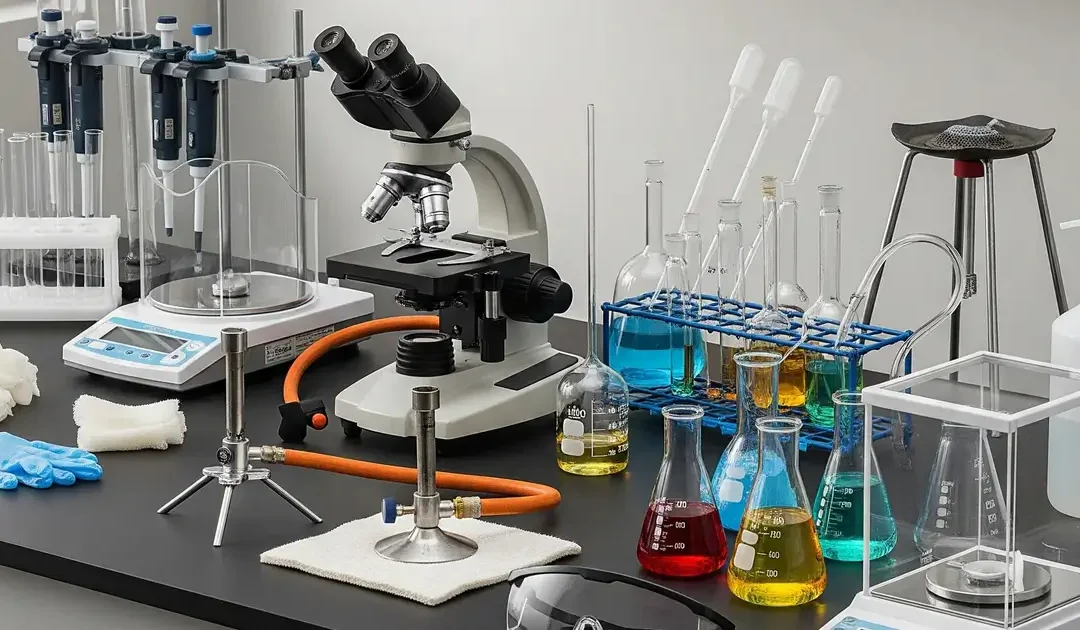
Setting up your first laboratory, or stepping into a new one, is one of the most exciting transitions in a scientific career. It is also one of the most practically overwhelming. The number of instruments, consumables, and supporting tools that a functional lab requires can seem endless when you are looking at an empty bench for the first time.
This guide cuts through that overwhelm. It covers the essential laboratory equipment every beginner needs to understand, organized by the role each instrument plays in a functioning lab workflow. You do not need to acquire all of this at once, but you do need to know what each piece does, how it fits into your work, and why it matters for producing reliable, reproducible results.
Measurement and Liquid Handling
Analytical balance: Precise mass measurement is the foundation of nearly every quantitative experiment. Analytical balances read to 0.0001 grams (four decimal places) and are essential for weighing reagents, preparing standard solutions, and ensuring that concentrations are accurately known from the outset. Even a small weighing error propagates through every subsequent calculation in an experiment.
Pipettes: Fixed-volume and variable-volume micropipettes are the instruments you will reach for more often than any other in your daily work. They transfer precise volumes of liquid between containers, prepare dilutions, set up reactions, and load samples onto analytical instruments. A full set covering ranges from 0.5 to 10 microliters, and 100 to 1,000 microliters covers most routine applications.
pH meter: Many biological and chemical processes are pH-dependent. A calibrated pH meter allows you to prepare buffers at the correct pH, adjust media before cell culture, and monitor reaction conditions. Regular calibration with two-point standard buffer solutions is essential for accurate readings.
Sample Separation and Preparation
Centrifuge: Centrifuges use centrifugal force to separate mixture components based on density differences. In a clinical or research lab, you will use a centrifuge to separate blood components, pellet cells from culture supernatant, clarify samples before analysis, and collect precipitates. Begin with a benchtop clinical centrifuge for routine separation work and add a microcentrifuge for molecular biology applications as your workflow expands.
The DM0412 Clinical Centrifuge from NE LabSystems is a strong entry point. It runs at 300 to 4,500 RPM, displays speed in both RPM and G-force, features a maintenance-free brushless motor, and meets IVD medical equipment standards. It handles 15 mL tubes, vacuum tubes with adapters, and includes an electric lid lock with automatic release for safe, repeatable operation.
Vortex mixer: Before any centrifuge run, samples and reagents often need thorough mixing. A vortex mixer creates rapid circular motion inside a tube, ensuring uniform suspension of particles and complete dissolution of reagents. It is fast, simple, and indispensable for consistent sample preparation.
Temperature Control
Water bath or dry bath incubator: Controlled temperature incubation is required for enzyme reactions, protein denaturation, hybridization steps, and sample conditioning. Dry bath incubators heat metal block inserts that hold tubes at precise temperatures without the contamination risk of water. They are a cleaner, more versatile choice for most routine incubation steps in molecular biology and clinical work.
Shaking incubator: If your work involves bacterial culture, protein expression, or solubility studies, a shaking incubator combines orbital agitation with temperature control. The ES-60 Incubator Series from NE LabSystems provides a temperature control range of RT+5 to 60 degrees Celsius with stability within plus or minus 0.3 degrees Celsius at 37 degrees, on a 20 mm circular orbit at 50 to 300 RPM. It is a reliable, well-supported starting point for labs moving beyond simple static incubation.
Freezer and refrigerator: Sample and reagent storage at correct temperatures preserves integrity between experiments. A standard laboratory refrigerator operates at 4 degrees Celsius for short-term storage of buffers, media, and enzyme stocks. A minus-20 degrees Celsius freezer stores enzymes, primers, aliquots, and other temperature-sensitive reagents for the long term. Ultra-low temperature freezers at minus-80 degrees are required for long-term storage of cell stocks and sensitive biological materials.
Analytical Instruments
UV-Visible spectrophotometer: This instrument measures how much light a sample absorbs at specific wavelengths, allowing you to quantify nucleic acids, proteins, enzyme reaction products, and chemical compounds in solution. It is among the most frequently used instruments in molecular biology, biochemistry, and analytical chemistry, and its applications span across disciplines from DNA quantification to pharmaceutical analysis.
Microplate reader: For labs running ELISA assays, cell viability tests, or any assay performed in a 96-well or 384-well plate format, a microplate reader automates absorbance, fluorescence, or luminescence measurements across all wells simultaneously, dramatically accelerating data collection versus a single-cuvette spectrophotometer.
Safety and Contamination Control
Personal protective equipment: Nitrile gloves, safety goggles, and a lab coat are non-negotiable before any lab work begins. These are not bureaucratic requirements. They are the minimum barriers between your skin, eyes, and respiratory system and the biological or chemical hazards you will encounter in routine lab work.
Biosafety cabinet: Any work with biological samples, cell cultures, or potential pathogens requires a certified biosafety cabinet (BSC) to protect both the operator and the sample. Class II Type A2 BSCs are the most common in research and clinical settings, providing HEPA-filtered airflow that protects both the work surface and the room environment.
Building Your Lab One Layer at a Time
The essential laboratory equipment list for beginners is not something you build all at once. Start with the instruments that directly support your first experimental goals, add measurement tools that ensure your quantitative work is reliable, and layer in safety equipment before anything else begins. As your work expands, so can your instrument inventory.
At NE LabSystems, we carry a full range of clinical and research lab equipment suited to labs at every stage of development, all backed by free extended warranties on U.S. purchases and support from engineers who understand what labs actually need. Browse the full catalog online or call (877) 733-6838 to discuss the right starting setup for your specific work.