
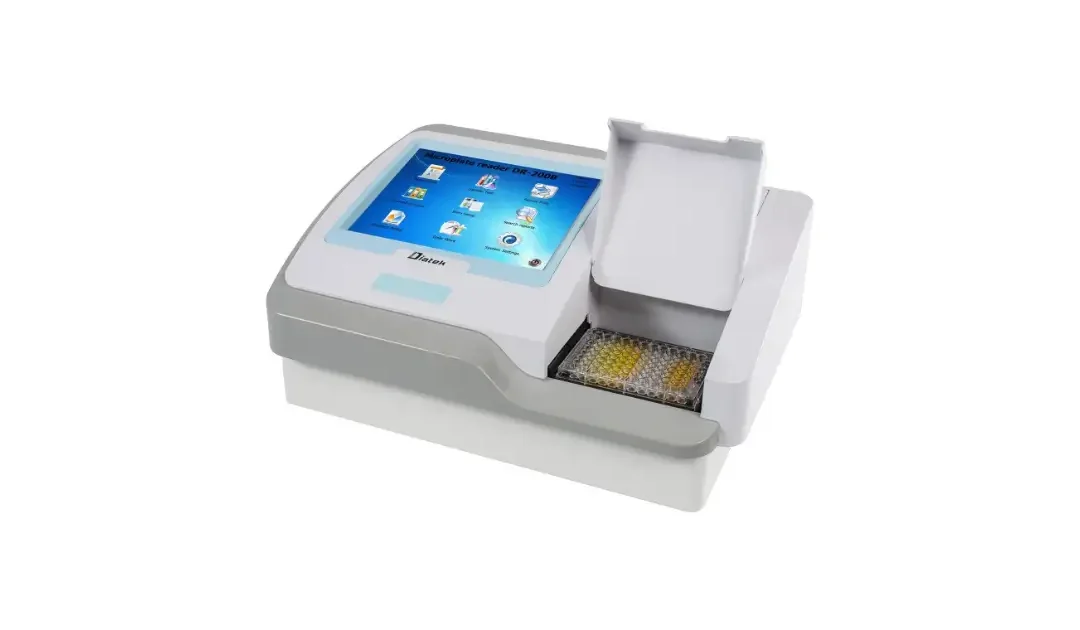
The ELISA reader for laboratory testing is the analytical engine at the end of every enzyme-linked immunosorbent assay workflow. After samples are loaded, antibodies are bound, enzyme conjugates are applied, and the substrate reaction has proceeded, the reader provides the optical measurement that converts the colorimetric or fluorescent signal into quantifiable data. Everything before the read step in an ELISA produces the signal; the reader is what measures it.
Understanding how ELISA readers work, what detection technologies they use, and how to select the right instrument for your laboratory is essential for labs where ELISA is a routine or high-volume procedure.
What An ELISA Reader Measures
An ELISA reader, formally an ELISA microplate reader, measures the optical signal produced in each well of a microplate after the assay reaction is complete. In the most common ELISA format, a colorimetric (absorbance) detection method is used: the enzyme conjugate reacts with a substrate to produce a colored product, and the reader measures how much light is absorbed by that product at a specific wavelength.
According to BMG Labtech’s technical documentation on ELISA plate readers, the two most encountered enzyme-substrate pairs in colorimetric ELISA are horseradish peroxidase (HRP) with TMB substrate, typically read at 450 nm, and alkaline phosphatase (ALP) with pNPP substrate, read at 405 nm. The intensity of color produced is directly proportional to the amount of target analyte in the sample, allowing concentration to be calculated from a standard curve.
Detection Technologies In ELISA Readers
Absorbance (colorimetric) detection is the standard for most routine ELISA assays. The reader passes light at the assay measurement wavelength through each well and measures the transmitted light intensity. The ratio of incident to transmitted light gives the absorbance value for that well. Dedicated ELISA absorbance readers are filter-based, using physical optical filters to select the measurement and reference wavelengths precisely.
Fluorescence detection is used in fluorescence-linked immunosorbent assays (FLISA) where a fluorescent label replaces the enzyme conjugate. Fluorescence ELISA offers significantly greater sensitivity than colorimetric methods, enabling detection of analytes at concentrations below the colorimetric assay’s detection limit. This is particularly valuable for low-abundance biomarkers in research and clinical applications.
Luminescence detection is used in bioluminescent or chemiluminescent ELISA formats where the enzyme produces light rather than color. The absence of an external light source eliminates background from well autofluorescence, providing extremely high signal-to-noise ratios and sensitivity levels orders of magnitude below conventional colorimetric methods.
Key Features Of The ELISA Reader For Laboratory Testing
Wavelength selection: For dedicated ELISA use, filter-based readers with the standard ELISA wavelengths (405, 450, and 492 nm, plus reference wavelengths around 600 to 630 nm) cover the vast majority of commercial assay kits. Berthold Technologies’ documentation notes that if additional assays beyond ELISA are anticipated, the number of available filter positions should be considered.
Plate format compatibility: Most clinical ELISA readers support 96-well plates and individual microstrips for partial-plate runs. Higher-throughput research environments may require 384-well plate capability for assay miniaturization.
Kinetic reading mode: For enzyme kinetics assays, enzyme activity measurements, and real-time reaction monitoring, a reader that supports kinetic mode, taking multiple measurements from each well at defined time intervals, is required.
Onboard data analysis: For clinical diagnostic environments, built-in curve-fitting software for four-parameter logistic (4PL) or point-to-point standard curve construction, combined with direct result reporting, eliminates the need for external data processing and reduces the risk of transcription errors.
The Stat Fax 4700 Elisa Reader
The Stat Fax 4700 ELISA Microstrip Reader from NE LabSystems provides dedicated absorbance reading for 96-well plates and microstrips, supporting the standard ELISA wavelengths for routine clinical diagnostic testing. Its microstrip capability allows partial plate runs, reducing reagent waste for lower-volume labs. Backed by free extended warranty coverage on U.S. purchases and factory-trained support, it is a reliable, cost-effective choice for clinical labs running standardized ELISA diagnostic panels. Browse the reader range at NE LabSystems or call (877) 733-6838.