
In laboratory temperature control, the difference between a static water bath and a circulating water bath is not simply a matter of price or features. It is a difference in the fundamental mechanism by which temperature is distributed and maintained throughout the bath chamber. That difference has direct consequences for result reproducibility, particularly in applications where multiple samples must be processed simultaneously under identical thermal conditions. Understanding laboratory circulator applications is therefore not just an equipment question. It is a quality question.
This guide explains how laboratory circulators work, the types available, and the specific applications where their temperature uniformity advantage matters most.
How a Laboratory Circulator Achieves Temperature Uniformity
A laboratory circulator incorporates an integrated pump that continuously moves the bath fluid throughout the chamber. This forced circulation prevents the temperature stratification that develops in static baths, where fluid near the heating element is warmer than fluid elsewhere. Thermoline Scientific’s technical documentation on circulating baths confirms that they offer uniform temperature distribution, improved heat transfer, and better temperature stability, making them ideal for experiments requiring high precision and consistency.
The circulating pump also accelerates heat transfer to sample vessels. When fluid is in continuous motion around a flask or tube, the rate at which heat transfers from the bath to the sample is higher than in a static bath where the fluid in contact with the vessel wall must be displaced by cooler fluid through slow natural convection. For laboratory circulator applications that require rapid temperature equilibration of newly added samples, this improved transfer rate is practically important.
Types of Laboratory Circulators
Heated circulators maintain temperatures from ambient plus approximately 5 degrees Celsius up to 100 or 150 degrees Celsius depending on the model and bath fluid used. They are the standard choice for enzyme assays, serological testing, pharmaceutical dissolution work, and sample incubation where elevated, precise temperatures are required.
Refrigerated and heated circulators provide both heating and cooling capability, reaching temperatures as low as minus 40 degrees Celsius on some models while also providing the full heating range. These are used in applications requiring precise temperature control below ambient, including cold-temperature kinetics studies, viscosity measurements, and temperature ramping protocols where both heating and cooling phases must be precisely controlled.
Immersion circulators are placed directly into an existing bath vessel rather than incorporating their own tank. They are useful for labs that already have bath chambers of the right size or need to retrofit precise circulation into an existing setup.
Key Laboratory circulator applications
Enzyme kinetics studies: Enzyme reaction rates are highly temperature-dependent. When multiple enzyme assays are run simultaneously in a circulating bath, every tube in the bath is at exactly the same temperature. This eliminates the positional temperature variability that would cause systematic differences in reaction rates between samples based on where they sat in the bath.
Serological and immunological testing: Serological complement fixation tests, agglutination tests, and related immunological assays require precise, consistent incubation that produces comparable results across all patient samples in a run. Cole-Parmer’s technical guidance on circulating baths notes that they are ideal for enzymatic and serological experiments where temperature uniformity and consistency are critical.
Viscosity standardization and rheology: Viscosity is a temperature-dependent property, and accurate viscosity measurements require that samples be maintained at precisely controlled temperatures throughout the measurement. Circulating baths provide the thermal stability and uniformity that viscometry and rheological measurements require for reproducible results.
Temperature-controlled chemical reactions: Reactions running in multiple vessels simultaneously must experience identical temperature conditions for rate data to be comparable between vessels. Circulating bath temperature uniformity ensures this comparability.
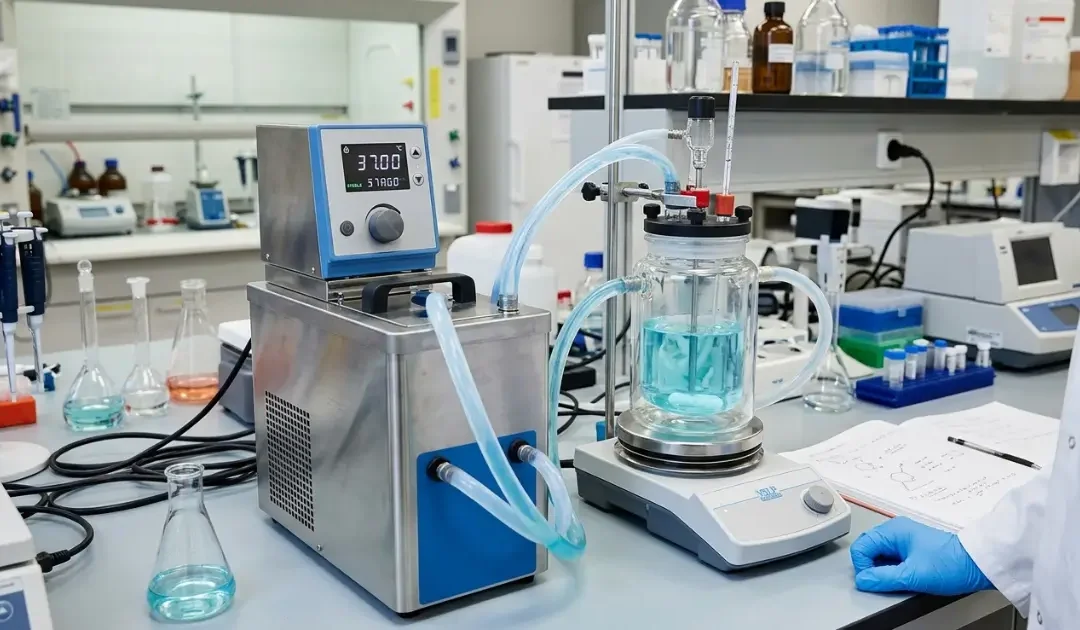
External temperature control of jacketed vessels: Circulators are used to pump temperature-controlled fluid through the jacket of a reaction vessel, maintaining the internal reaction temperature while allowing sampling and stirring access. This is standard practice in organic synthesis, fermentation, and process chemistry.
Choosing Between a Circulating Bath and a Static Bath
The decision hinges on whether temperature uniformity across sample positions matters for your application. If you routinely incubate a single sample or process vessels sequentially, a static bath is adequate and more economical. If you process multiple samples simultaneously and need results to be comparable between all positions, or if your application involves enzyme kinetics or serological testing, a circulating bath is the appropriate instrument for laboratory circulator applications of this type.
At NE LabSystems, we carry circulating and non-circulating water baths suited to the full range of laboratory temperature control requirements, backed by free extended warranties on U.S. purchases. Browse the full range online or call (877) 733-6838 for a recommendation matched to your specific application.