
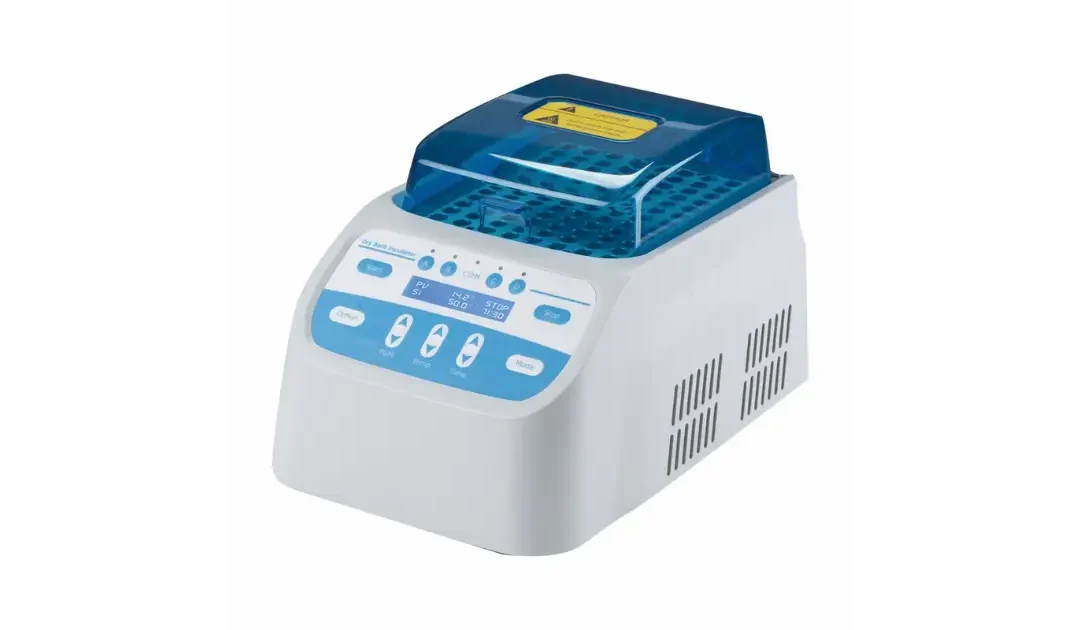
The laboratory dry bath incubator, also known as a heat block incubator or dry block heater, has become one of the most commonly used temperature control instruments in modern molecular biology, clinical chemistry, and pharmaceutical research. Its core principle is elegant: instead of heating a liquid medium that then heats a sample vessel from the outside, a dry bath heats a precision-machined metal block that contacts the sample tube directly through conduction. The result is fast, precise, contamination-free heating that is simpler to operate and maintain than a water bath, and better suited to a wide range of small-tube applications.
This guide covers what a laboratory dry bath incubator does, where it outperforms alternatives, and what to look for when selecting one for your lab.
How A Dry Bath Incubator Works
A dry bath incubator contains one or more aluminum heating blocks with precisely machined wells that accept specific tube formats. The heating element warms the block to the set temperature, and heat transfers from the block surface directly to the tube wall through conduction. A PID (proportional-integral-derivative) temperature controller monitors the actual block temperature via a sensor and adjusts the heater output to maintain the set point accurately. This direct-contact heating method reaches set temperatures quickly and holds them with high stability.
The block design is the key to the instrument’s versatility. Interchangeable blocks accommodate different tube formats, from 0.2 mL PCR tubes and 0.5 mL microtubes through 1.5 mL and 2 mL standard microcentrifuge tubes to 15 mL and 50 mL conicals on larger models. A single dry bath incubator with multiple block inserts serves effectively as a universal small-volume heating station for an entire laboratory.
Key Uses Of The Laboratory Dry Bath Incubator
PCR preparation and denaturation: Many PCR protocols include a denaturation step at 95 to 100 degrees Celsius to separate double-stranded DNA template strands before cycling. A dry bath incubator reaches and holds these temperatures quickly and precisely, making it the standard pre-PCR heating instrument in molecular biology labs.
Enzyme reactions: Restriction digestion, ligase-mediated joining, and kinase reactions all require precise incubation at specific temperatures, typically 37 degrees Celsius for most restriction enzymes and ligases. The dry bath’s temperature accuracy within plus or minus 0.3 to 0.5 degrees Celsius ensures the enzyme operates under exactly the conditions the manufacturer characterized.
Blood serum analysis: According to Drawell Analytical’s technical documentation on dry bath applications, clinical and diagnostic laboratories use laboratory dry bath incubators for blood serum analysis, coagulation studies, and enzymatic reactions, where precise temperature control is essential for accurate test results, and the contamination-free heating method is beneficial for handling biological samples.
Drug stability testing: In pharmaceutical research, dry baths are used for drug stability testing and compound synthesis. Many biochemical assays require controlled heating, and dry baths provide the necessary precision for reactions involving small volumes.
Sample denaturation and deproteinization: Protein denaturation at elevated temperatures before gel electrophoresis or downstream analysis is a routine application where the rapid heating of a dry bath is more practical than waiting for a water bath to bring a large volume of water to temperature.
Advantages Over Water Baths For Small-Volume Applications
The contamination advantage is significant in biological settings. Water baths maintain standing liquid at 37 degrees Celsius, which is the optimal temperature for microbial growth. Without consistent cleaning and monitoring, water baths develop biofilm and microbial contamination that can affect samples. Dry bath incubators have no standing liquid, no growth medium, and no contamination risk between samples.
Maintenance is considerably simpler. No water evaporation to compensate, no mineral buildup to address, no risk of fungal or bacterial colonization. A dry bath requires cleaning of block wells when spillage occurs and periodic performance verification. This lower maintenance burden translates to less downtime and lower operational cost over the instrument’s service life.
Temperature range is extended compared to standard water baths. While water baths are constrained by the boiling point of water at approximately 100 degrees Celsius, dry bath incubators reach up to 130 degrees Celsius on many models, enabling applications at temperatures water baths simply cannot sustain.
Selecting The Right Dry Bath Incubator
The primary selection criteria for a laboratory dry bath incubator are the tube formats you need to accommodate (which determines block compatibility), the temperature range required for your protocols, the number of simultaneous samples you run, and whether digital temperature display and timer functions are required for documented protocol compliance.
At NE LabSystems, we carry dry bath incubators suited to clinical and research laboratory applications, all backed by free extended warranties on U.S. purchases. Browse our dry bath range or call (877) 733-6838 for a recommendation matched to your specific protocols and tube formats.