
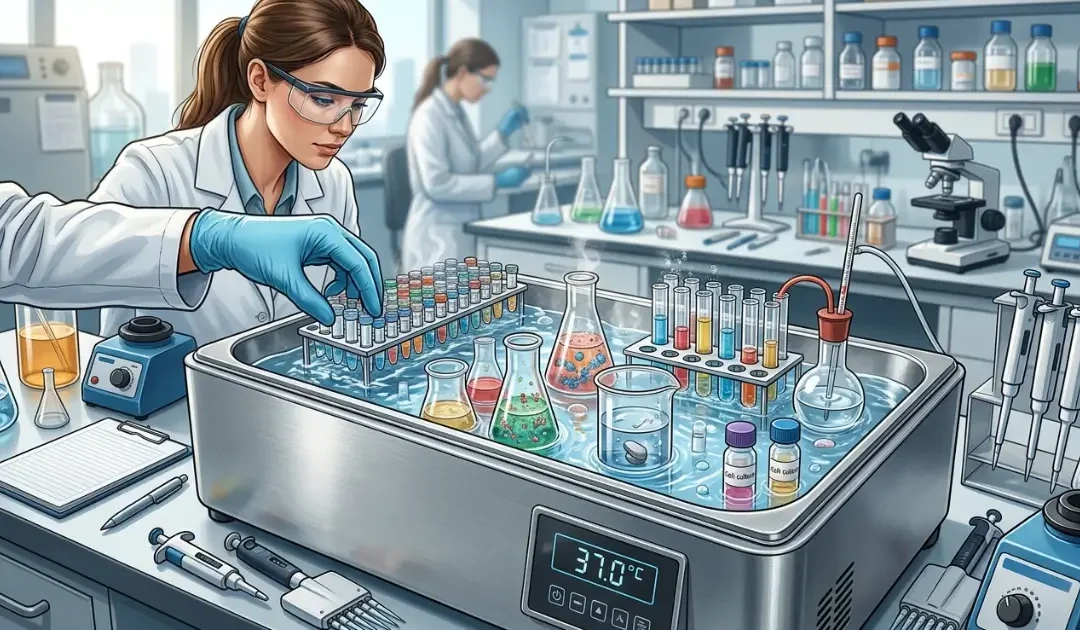
Few instruments in scientific research have remained as consistently relevant as the laboratory water bath. It has been a staple in clinical, research, and industrial laboratories for well over a century, and for good reason: water is one of the most effective natural heat transfer media available. Its high thermal capacity, uniform convective distribution, and gentle contact with sample vessels make it ideal for applications that require stable, sustained, and even heating. Understanding the full scope of laboratory water bath uses is the starting point for getting maximum value from this versatile instrument.
This guide covers the major applications of the laboratory water bath across disciplines, explaining why water-based heating is preferred for each and what parameters to control.
Thawing Frozen Biological Samples
One of the most frequent laboratory water bath uses in clinical and research settings is the controlled thawing of frozen biological samples. A water bath set to 37 degrees Celsius is the standard laboratory tool for this task, ensuring that thawing is quick and uniform, which minimizes the formation of damaging ice crystals that can rupture cell membranes and degrade nucleic acids. According to Hinotek’s technical documentation on water bath applications, the water bath ensures consistent, reliable thawing of serum, plasma, and urine samples stored frozen, avoiding the rapid or uneven thawing that can alter analyte concentrations.
In blood banks and transfusion medicine, thawing frozen plasma and cryoprecipitate requires precise temperature control to avoid overheating, which degrades clotting factors, while ensuring complete thawing, which affects product availability. The water bath provides exactly the controlled thermal environment this application demands.
Sample Incubation at Controlled Temperatures
Incubating samples at defined temperatures for defined periods is one of the most fundamental requirements across clinical chemistry, microbiology, and biochemistry. Water baths support this function by maintaining the set temperature with minimal variation over extended incubation periods. Clinical chemistry tests for enzyme activity, coagulation studies, and serological testing all require incubation steps at specific temperatures, typically 37 degrees Celsius, where even minor deviations affect reaction kinetics and result accuracy.
Microbiological culture work uses water baths for incubating culture media at temperatures that favor the growth of target organisms. The water surrounding the culture vessel provides even heating that gravity-convection air incubators cannot match for small-volume cultures in tubes or bottles.
Heating Chemical Reactions
In chemistry and pharmaceutical laboratories, water baths are the preferred heat source for heating flammable chemicals. According to Wikipedia’s scientific instrumentation documentation, laboratory water baths are preferred heat sources for heating flammable chemicals because their lack of open flame prevents ignition. This is a critical safety advantage in any laboratory working with organic solvents, ethanol-containing reagents, or flammable extraction solvents.
Reagent preparation for clinical assays frequently requires heating buffer components, enzyme substrates, or chromogenic reagents to specific temperatures before use. A water bath provides the controlled, consistent heating environment that ensures reagents reach the required temperature without localized overheating that could denature proteins or degrade substrates.
Warming Reagents and Media
Cell culture workflows require that media and buffers be warmed to 37 degrees Celsius before use to prevent cold shock to cells during feeding or passaging. A water bath provides reliable, consistent warming for multiple media bottles or buffer aliquots simultaneously. Temperature-sensitive enzyme substrates, serum supplements, and specialized growth additives also benefit from gentle, even warming before addition to cultures.
Melting Agar and Temperature-Sensitive Materials
Microbiological laboratories routinely melt and maintain agar in the pourable state for plate preparation. Water baths maintain agar at 45 to 50 degrees Celsius, the temperature range in which agar remains liquid but does not harm temperature-sensitive supplements added before pouring. Paraffin wax, sealing agents, and other temperature-sensitive materials used in histology and materials science are similarly maintained in the water bath.
Enzyme and Serological Applications
Enzymatic assays and serological tests are among the most demanding laboratory water bath uses in terms of temperature precision. Enzyme kinetics are highly temperature-dependent, and reaction rate varies significantly with even small temperature deviations from the optimum. Circulating water baths are particularly recommended for enzymatic and serological applications because the pump-driven water circulation produces the temperature uniformity across all sample positions that these applications require.
Pharmaceutical Research and Dissolution Testing
In pharmaceutical development, water baths support dissolution testing of tablets and capsules at 37 degrees Celsius, replicating gastrointestinal conditions. Drug stability testing, compound solubility studies, and formulation development workflows all rely on water baths for the precise, sustained temperature control that produces reproducible results across test runs.
Getting the Most from Your Laboratory Water Bath
The range of laboratory water bath uses described above reflects how broadly this instrument serves across scientific disciplines. Selecting the right bath type, whether a standard circulating model for uniform multi-sample incubation or a shaking bath for combined heating and agitation, determines how well the instrument serves your specific application.
At NE LabSystems, we carry a full range of laboratory water baths suited to clinical, research, and pharmaceutical laboratory needs, all backed by free extended warranties on U.S. purchases and factory-trained engineering support. Browse the full water bath range at NE LabSystems or call (877) 733-6838 for a recommendation matched to your workflow.