
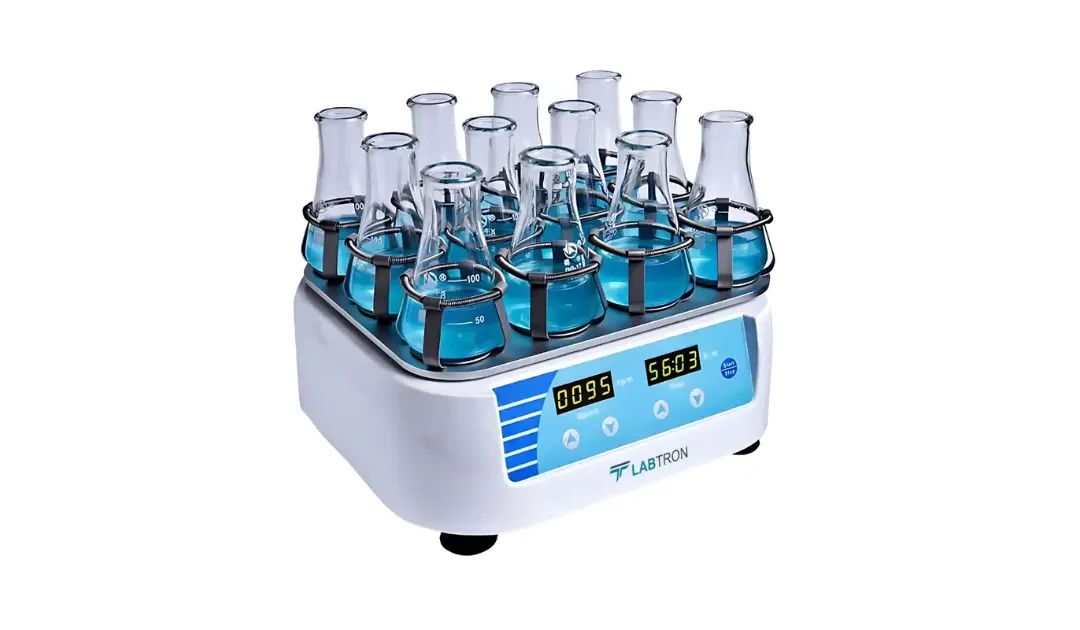
Orbital shakers are among the most frequently used instruments in modern laboratories, and also among the most frequently misused. The misuse is rarely dramatic. It does not typically result in visible sample failures or obvious protocol breakdowns. It shows up more quietly: bacterial cultures that grow inconsistently between runs, protein expression yields that vary without clear explanation, gel staining that leaves behind background even after what appears to be adequate washing. In most of these cases, the orbital shaker RPM setting is the overlooked variable.
Matching orbital shaker speed to your specific application is not guesswork, and it is not a matter of running at a fixed default. It is a calibrated decision based on your sample type, your vessel format, your orbit diameter, and the specific biological or chemical outcome you are trying to achieve. This guide gives you the framework for making that decision correctly, with specific speed ranges grounded in industry-established practice.
How Orbital Motion Produces Its Effect
An orbital shaker moves its platform in a circular, horizontal path at a controlled speed. This motion creates a swirling pattern in the liquid inside any vessel placed on the platform, drawing fluid up the sides of the flask and back down through the center in a repeating pattern. The practical result is two simultaneous effects: mixing of the liquid contents, and gas transfer at the liquid surface.
The gas transfer effect is why orbital shaker speed matters so much for aerobic biological applications. Oxygen dissolves into culture media through the liquid surface, and the area of that surface in motion determines the oxygen transfer rate (OTR). According to Fisher Scientific’s orbital shaker selection guidance, orbital shaker speed directly affects oxygen transfer rate and therefore cell culture growth. Higher speeds increase surface motion and OTR; lower speeds reduce it. For aerobic organisms, this translates directly to growth rate, yield, and metabolite production.
Bacterial Culture: 200 To 250 RPM
Bacterial suspension cultures are the most common high-speed application for orbital shakers. For standard aerobic bacteria like Escherichia coli, Bacillus subtilis, and similar organisms, orbital shaker RPM settings of 200 to 250 RPM are commonly used in published laboratory protocols and industry guidance from sources including Bitesize Bio’s bacterial culture optimization resource. This speed range generates sufficient surface agitation in standard Erlenmeyer flasks to maintain dissolved oxygen above the concentration that limits growth, while keeping physical force on the cells within safe limits.
The specific optimal speed within this range depends on your flask volume and flask size. A 250 mL culture in a 500 mL Erlenmeyer flask at 200 RPM behaves differently from the same culture in a 1,000 mL flask at the same speed. As fill volume increases relative to flask capacity, the ratio of liquid volume to headspace decreases, reducing gas exchange efficiency. Compensating with slightly higher RPM or using a lower fill ratio maintains adequate oxygenation. A general guideline is to use fill volumes of no more than 20 to 25 percent of total flask capacity for aerobic bacterial cultures.
Yeast Culture: 120 To 300 RPM
Yeast cultures tolerate and require a broader speed range than most bacterial applications. Standard Saccharomyces cerevisiae aerobic cultures typically run at 150 to 200 RPM in Erlenmeyer flasks. More vigorous fermentation protocols or smaller flask sizes may use speeds up to 250 to 300 RPM to maintain adequate oxygenation. Anaerobic yeast cultures run at lower speeds since oxygen transfer is not the goal and excessive agitation would only cause mechanical stress to the cells.
For yeast used in protein expression, particularly heterologous expression systems like Pichia pastoris, maintaining consistent speed and temperature is critical for expression yield reproducibility. Even minor variations in agitation, whether from inconsistent RPM maintenance or position on the platform, can produce batch-to-batch variability in expression levels.
Mammalian And Insect Cell Cultures: 30 To 100 RPM
Mammalian cells are among the most mechanically sensitive organisms routinely cultured in laboratory settings. Their lack of a rigid cell wall makes them vulnerable to shear stress in a way that bacteria and yeast are not. This means that the orbital shaker RPM for mammalian cell applications must be kept significantly lower than for microbial cultures.
According to Scilogex’s technical application guidance, mammalian cell cultures typically require gentle speeds in the range of 30 to 100 RPM. The primary goal at these speeds is maintaining nutrient distribution throughout the culture medium, preventing cell settling on the flask bottom, and ensuring that metabolic byproducts are distributed away from the cells. Oxygen transfer is less critical because most mammalian cell culture flasks used on orbital shakers are vented flasks or are incubated in CO2 incubators where gas exchange is provided through the flask cap.
Insect cell cultures, including Sf9 and High Five cells used in baculovirus expression systems, are somewhat more robust than mammalian cells but still require careful attention to shear stress. Typical insect cell suspension culture runs at 100 to 130 RPM in Erlenmeyer flasks on a 20 mm orbit shaker.
Gel Staining, Destaining, And Blotting: 15 To 70 RPM
At the low end of the orbital shaker RPM range, orbital motion provides gentle, even coverage of flat surfaces rather than the liquid depth mixing needed for suspension culture. Gel staining and destaining protocols use this low-speed range to ensure that staining solution or destaining buffer covers the gel surface uniformly without generating the vigorous motion that would fragment or tear the gel.
According to HINOTEK’s orbital shaker buyer’s guide, fragile samples such as gels for staining or blot incubations require very low speeds in the range of 15 to 70 RPM. Western blot incubation with primary or secondary antibody typically runs at 20 to 40 RPM, providing enough motion to keep antibody solution circulating over the membrane surface without creating conditions that could cause antibody aggregation or membrane distortion.
Protein Expression And Solubility Studies: 120 To 200 RPM
Recombinant protein expression protocols using E. coli or other expression hosts typically run orbital shakers at 120 to 200 RPM, with the specific optimal speed depending on the expression host, flask format, and the protein being expressed. Lower temperatures used in many protein expression protocols, typically 16 to 25 degrees Celsius to improve soluble protein yield and reduce inclusion body formation, mean that refrigerated orbital shakers are often required for these applications.
Protein solubility studies and binding assays that use enzyme-coated or antibody-coated plates run at low speeds, typically 50 to 100 RPM for plate-based assays, to ensure even distribution of the incubating solution without washing solution off the plate surface. The specific optimal speed is determined empirically for each assay format.
The SCI-O180-Pro: An Orbital Shaker Built For Precision
For labs needing programmable, precise speed control across the full application range covered by this orbital shaker RPM guide, the SCILOGEX SCI-O180-Pro Orbital LCD Digital Shaker, available through NE LabSystems, covers a speed range of 100 to 800 RPM with a 10 mm orbital action. The brushless DC motor ensures consistent, maintenance-free speed delivery. Backlit dual LCD displays show speed and timer independently, and the RS232 remote function supports PC control and data logging for documented protocol reproducibility. With a load capacity of 2.5 kg, cold room and incubator compatibility, and multi-voltage compatibility, it serves bacterial culture, protein expression, cell-based assays, and general mixing applications from a single instrument. Backed by a 2-year warranty and free extended warranty on U.S. purchases through NE LabSystems, it is a well-supported choice for labs that take their agitation protocols seriously.