
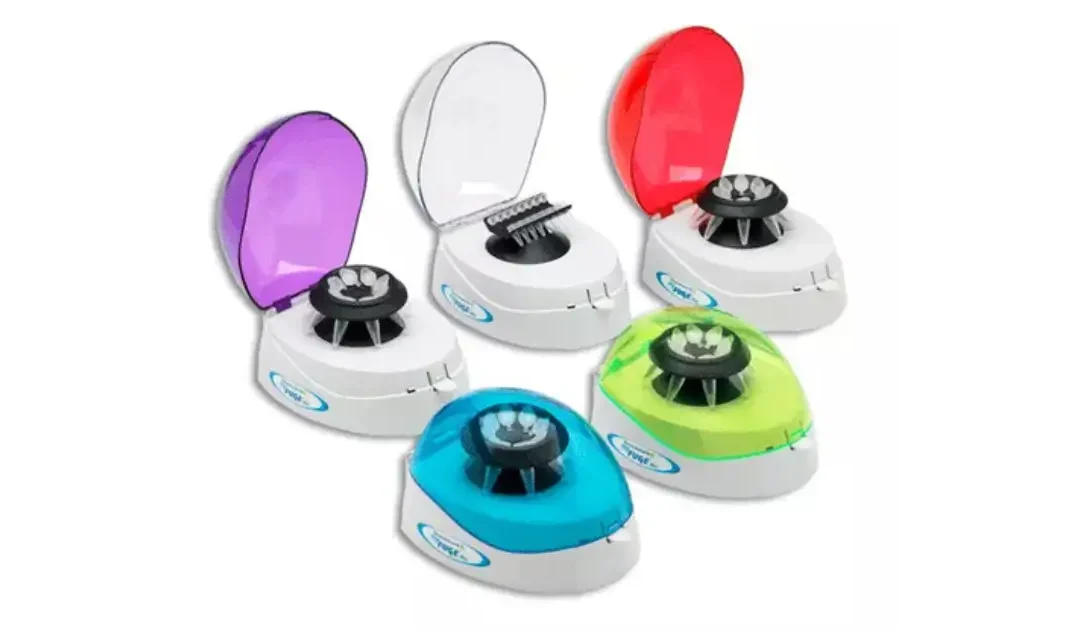
Bench space in a working lab is a finite and fiercely guarded resource. Every instrument that takes up more room than it needs to is an instrument that has displaced something else. That is why mini centrifuges have become one of the most practical choices in modern molecular biology, clinical, and research settings. They deliver the centrifugal force your sample preparation workflow requires in a footprint that often takes up less than half a square foot of bench space.
The right mini centrifuge does not compromise on performance to achieve that compact size. It handles PCR strips, 1.5 mL and 2 mL microtubes, 0.5 mL tubes, and 0.2 mL tubes with speed and reliability. This guide covers the top five options for labs that need real performance without sacrificing the bench space they cannot afford to lose.
What To Look For In Mini Centrifuges For Compact Lab Spaces
Before diving into specific models, it helps to know what variables actually matter when choosing a mini centrifuge for a space-constrained lab.
- Speed range: Most mini centrifuges operate between 2,000 and 10,000 RPM. For general spin-downs and quick collections of liquid from tube walls and caps, a fixed-speed or lower variable-speed model is sufficient. For more demanding sample preparation, such as pelleting cells or small-scale protein work, a model capable of 10,000 RPM or higher gives you greater flexibility.
- Tube and rotor compatibility: Look for models that accommodate 1.5 mL and 2 mL microtubes as standard, with adapters for 0.5 mL and 0.2 mL tubes and PCR strips. Interchangeable rotors let a single instrument serve multiple protocols without requiring a separate unit for each tube format.
- Safety features: A lid interlock that prevents operation when open is the minimum acceptable safety standard. Better models add automatic braking when the lid is lifted and imbalance detection that stops the rotor before damage occurs.
- Noise and vibration: Mini centrifuges are often used at individual workstations. Models with brushless, maintenance-free motors run significantly quieter than older motor designs and produce less vibration, which matters both for user comfort and for the stability of sensitive materials running in adjacent instruments.
1.NE LabSystems Mini Centrifuge (10K Variable Speed)
The Mini Centrifuge from NE LabSystems is a strong first choice for labs that need variable speed control across a full range of sample types. It reaches 10,000 RPM and features a large-radius 8-hole rotor that generates 1.5 times more centrifugal force than a standard 6-hole rotor at the same speed, making it more effective per spin for the same energy input. It handles 1.5 mL and 2 mL tubes as standard and accepts adapters for 0.5 mL and 0.2 mL tubes and PCR strips. The clip-on rotor design makes rotor exchange genuinely convenient, and the maintenance-free motor runs quietly and stably. It is backed by NE LabSystems’ free extended warranty on U.S. purchases.
2.NE LabSystems Ezee Mini Centrifuge
The Ezee Mini Centrifuge is designed specifically for microfiltration and quick spin-downs. Its defining feature is its operating mechanism: simply close the lid to start, and open it to stop. There is no programming required, no speed dial to adjust, and no timer to set. For labs that use their mini centrifuge primarily to collect liquid from the walls and caps of microtubes before proceeding to the next step, this level of simplicity is genuinely useful. The compact design takes up less than six inches of bench space. Available in four translucent lid colors, it includes an 8-place 1.5/2.0 mL rotor and a 16-position PCR tube rotor with 0.2 mL and 0.5 mL adapters as standard.
3.NE LabSystems High-Speed Mini Centrifuge
For labs that need maximum speed in a minimal footprint, the High-Speed Mini Centrifuge from NE LabSystems delivers a compact design with high-end performance. It fits comfortably on any workstation, making it well-suited for individual bench setups in molecular biology, genomics, and biochemistry labs where high-speed spins are a routine part of sample preparation. Its brushless motor design ensures quiet operation and long service life without maintenance requirements.
4.Fixed-Speed 10K Mini Centrifuge
For labs that need a reliable, no-frills spin-down centrifuge and do not require variable speed control, a fixed 10,000 RPM mini centrifuge is a smart choice. The fixed-speed design eliminates the controller complexity, reducing the points of potential failure and simplifying operation. It accommodates 8-hole rotors that handle 1.5 mL and 2 mL tubes, with adapters for smaller formats. These models are quiet, stable, and ideally suited for individual workstations where the centrifuge is used frequently but briefly throughout the day.
5.Compact Benchtop Mini Centrifuge With PCR Strip Rotor
Mini centrifuges with dedicated PCR strip rotor capability are essential for molecular biology labs that run PCR regularly. After assembly of PCR master mixes in 8-strip or 12-strip tube formats, a quick spin collects all liquid to the bottoms of the tubes and eliminates air bubbles before cycling, which is a critical step for consistent amplification. A compact benchtop model with a dedicated strip rotor and a standard 1.5/2 mL rotor gives PCR labs everything they need in one instrument, occupying minimal bench real estate.
Choosing the Right Mini Centrifuge for Your Lab
For most molecular biology and clinical labs, the NE LabSystems Mini Centrifuge with variable 10K speed is the most versatile all-around choice. For labs that prioritize absolute simplicity and minimal bench footprint for quick spin-down tasks, the Ezee Mini Centrifuge is the better fit. For demanding high-speed applications, the High-Speed Mini Centrifuge handles the workload without requiring a larger instrument.
All mini centrifuges in the NE LabSystems catalog are backed by free extended warranties on U.S. purchases and supported by factory-trained engineers who understand real lab demands. Browse the full range at NE LabSystems or call (877) 733-6838 to find the model that fits your bench, your workflow, and your budget.