
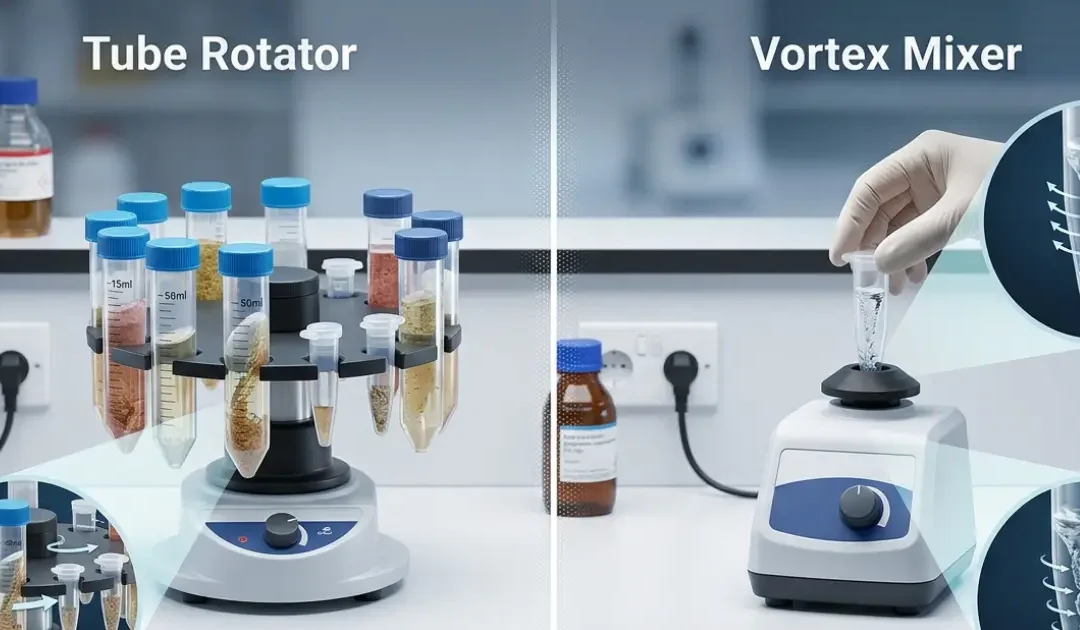
Mixing is such a fundamental part of laboratory work that it is easy to treat it as a solved problem. You have some kind of mixer on your bench, and it mixes things. The trouble is that not all mixing is the same, not all samples respond the same way to the same mixing force, and the wrong mixing device for a given application introduces variability that can follow your results all the way to the final analysis without ever being identified correctly.
The tube rotator vs vortex mixer comparison is one of the most common mixing equipment decisions labs face, and it is one where the wrong choice is far more consequential than most people realize. This guide explains what each instrument actually does, where each one excels, where each one fails, and how to match the right mixing device to your specific applications.
What A Vortex Mixer Does
A vortex mixer operates through a simple but effective mechanism: an electric motor with an eccentrically mounted rubber cup creates rapid circular motion when activated. When a tube is pressed against the cup, that motion is transmitted to the liquid inside, creating a vortex that mixes the contents quickly and thoroughly from the center outward. Most vortex mixers operate in either touch mode, where mixing occurs only while the tube is pressed against the cup, or continuous mode, where the motor runs until switched off. Variable speed models range from 100 to 3,200 RPM.
Vortex mixers are optimized for speed and intensity. They produce vigorous agitation in a matter of seconds, making them ideal for quick resuspension of pellets after centrifugation, rapid dissolution of dry reagents, brief homogenization of small-volume samples, and any mixing task that needs to be done immediately and completely before proceeding to the next step. According to Wikipedia’s scientific instrumentation documentation, vortex mixers are designed with variable speed settings ranging from 100 to 3,200 RPM and can be set to run continuously or to run only when downward pressure is applied.
What A Tube Rotator Does
A tube rotator provides 360-degree end-over-end rotation or orbital disk rotation at low, consistent speeds, typically between 10 and 80 RPM. The motion is gentle and continuous, designed to keep samples in uniform suspension over extended periods without generating the shear forces or bubble formation that vortex mixing produces. The tube rotator vs vortex mixer distinction in motion type is fundamental: one produces intense, brief agitation; the other provides gentle, prolonged movement.
End-over-end rotation continuously inverts the tube, ensuring that the sample flows from one end to the other with every revolution. This motion is ideal for applications where gravitational settling would occur during the incubation period without mixing: bead-based immunoprecipitation, nucleic acid extraction with prolonged lysis buffer contact, blood sample anticoagulation prevention during pre-analytical holding, hybridization, and protein binding studies.
When To Use A Vortex Mixer
A vortex mixer has several practical applications. This includes:
1.Pelleted cell resuspension after centrifugation:
After spinning down cells or proteins, brief vigorous vortexing breaks up the pellet quickly and resuspends material that is too tightly packed for gentle rotation to move.
2.Quick reagent dissolution:
When dissolving powder reagents into solution before use, vortex mixing at high speed completes dissolution rapidly and completely, which is important for time-sensitive protocol steps.
3.Brief sample homogenization:
For multi-component reagent preparations that need thorough mixing immediately before use, a short vortex cycle ensures uniform distribution before the preparation is applied to samples.
When NOT to vortex:
Partially frozen samples should never be vortexed because the shear forces generated can cause DNA fragmentation. Highly viscous samples can form bubbles during vortexing that persist and interfere with downstream pipetting. Biological samples containing intact cells or fragile proteins should not be vortexed unless the protocol specifically calls for it, as shear forces can damage cell membranes and denature proteins.
When To Use A Tube Rotator
It’s often best to rely on a tube rotator when the situation includes:
1.Immunoprecipitation:
IP protocols require antibody-bead complexes to remain in continuous contact with the target protein in lysate over 1 to 16+ hours. End-over-end rotation maintains bead suspension throughout the incubation without the shear that would affect protein conformation or binding.
2.Blood sample handling:
Anticoagulated blood tubes held before batch processing require gentle continuous inversion to prevent cell settling and maintain sample homogeneity. Vortexing would cause hemolysis; rotation maintains the sample without damaging the cellular components.
3.Nucleic acid extraction:
Lysis buffer incubation steps in DNA and RNA extraction protocols benefit from rotation that maintains even contact between the buffer and the sample without the shear that could fragment long genomic DNA.
4.Latex agglutination assays:
Latex particle-based diagnostic tests require continuous, gentle mixing to keep particles in suspension without causing aggregation. Vortexing causes particle aggregation; rotation at controlled low speed maintains optimal suspension.
Tube Rotator Vs Vortex Mixer: Choosing Based On Your Protocol
The decision is straightforward once you match the instrument to the application. The tube rotator vs vortex mixer choice comes down to three questions: How long does the mixing need to continue? How sensitive is the sample to shear stress? And what is the mixing goal: immediate thorough blending or sustained gentle suspension?
If you need mixing for seconds to minutes to complete a quick resuspension or dissolution, a vortex mixer is the right tool. If you need mixing for 30 minutes to several hours to maintain suspension or ensure reagent contact during an incubation, a tube rotator is the right tool. If your sample is a fragile protein, intact cells, or nucleic acids at risk of shearing, use the rotator. If your sample is a pellet that needs to be broken up or a dry reagent that needs to dissolve, use the vortex mixer.
Products That Cover Both Needs
At NE LabSystems, we carry both tube rotators and vortex mixers suited to the full range of laboratory mixing needs. The SCI-RD-Pro LCD Digital Tube Rotator Mixer provides gentle end-over-end rotation for 1.5 mL to 50 mL tubes with LCD digital control and a programmable timer, ideal for immunoprecipitation, blood mixing, and bead-based applications. Our vortex mixer range covers fixed and variable speed models for quick, high-intensity mixing applications. All instruments are backed by free extended warranties on U.S. purchases. Browse the full mixing equipment range online or call (877) 733-6838 for a recommendation matched to your specific sample types and protocol requirements.