
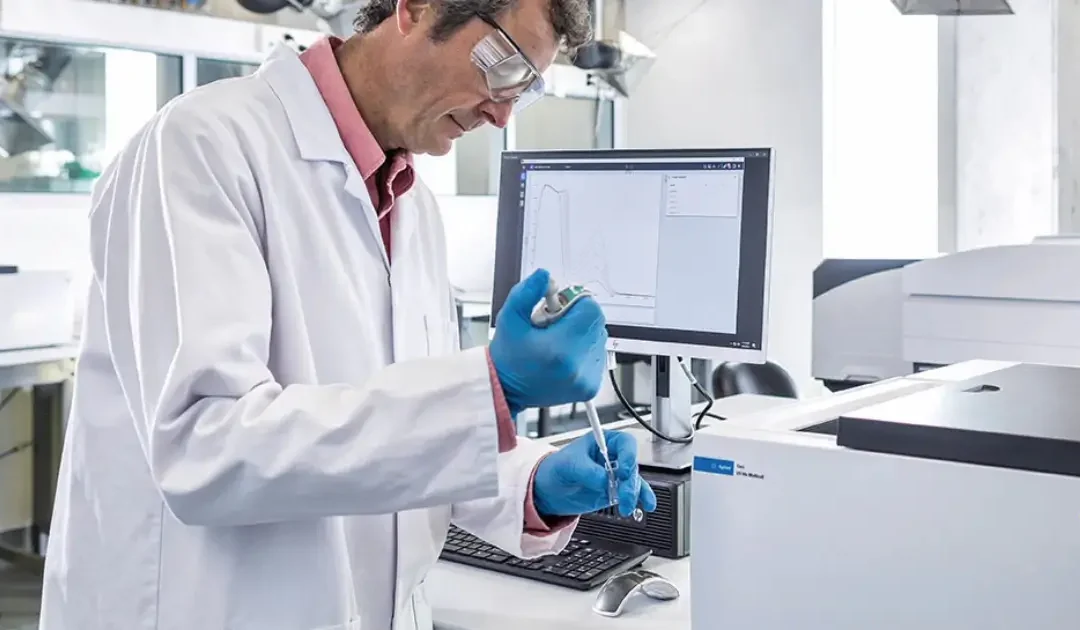
If you work in a clinical, research, pharmaceutical, or environmental laboratory and you have not yet spent time understanding the full range of UV spectrophotometer uses in laboratory analysis, you are almost certainly underutilizing one of the most powerful instruments in your facility. Most users know it as a tool for measuring concentration. Far fewer appreciate the breadth of what it can actually do across analytical disciplines.
The UV spectrophotometer is one of the most widely applied instruments in modern analytical science. It is fast, non-destructive, sensitive, and based on well-established physics that has underpinned quantitative chemistry for over a century. This guide covers what the instrument actually measures, the principle it operates on, and the full range of applications across laboratory disciplines.
The Working Principle: Beer-Lambert Law
Every UV spectrophotometer used in laboratory analysis is grounded in one foundational relationship: the Beer-Lambert Law. This law states that the absorbance of a solution is directly proportional to the concentration of the absorbing substance and the path length of the light beam through the sample. Expressed mathematically: A = ε × c × l, where A is absorbance, ε is the molar absorptivity coefficient (a constant specific to the compound and wavelength), c is the concentration, and l is the path length of the cuvette.
In practical terms, this means that if you know the molar absorptivity of your compound at a specific wavelength, measuring how much light is absorbed by your sample at that wavelength allows you to calculate the concentration directly. This simple but powerful relationship forms the quantitative basis of spectrophotometric analysis across every field where the instrument is used.
The instrument works by passing light of a selected wavelength through a sample cuvette and measuring the ratio between the intensity of the incident light and the intensity of the transmitted light. The difference between these two values, expressed logarithmically, is the absorbance reading.
UV Spectrophotometer Uses in Molecular Biology
Nucleic acid quantification is one of the most common uses of UV spectrophotometers in modern laboratory analysis. DNA and RNA absorb UV light maximally at 260 nanometers. By measuring absorbance at 260 nm, you can calculate the concentration of nucleic acids in a solution using established conversion factors: an absorbance of 1.0 at 260 nm corresponds to approximately 50 micrograms per milliliter of double-stranded DNA, 40 micrograms per milliliter of single-stranded RNA, and 33 micrograms per milliliter of single-stranded DNA.
The ratio of absorbance at 260 nm to absorbance at 280 nm (A260/A280) is used to assess nucleic acid purity. A ratio of approximately 1.8 is considered pure for DNA, and approximately 2.0 for RNA. Ratios below these values indicate protein contamination or residual phenol from extraction procedures, both of which absorb at 280 nm.
Protein quantification uses UV absorbance at 280 nm, where the aromatic amino acids tryptophan and tyrosine absorb strongly. Direct UV measurement at 280 nm is a quick, non-destructive method for estimating protein concentration, though it requires knowledge of the protein’s extinction coefficient for precise quantification.
UV Spectrophotometer Uses in Pharmaceutical Analysis
In pharmaceutical laboratories, UV spectrophotometry is applied across the full drug development and quality control pipeline. The United States Pharmacopeia (USP) includes spectrophotometric methods as official test procedures for many pharmaceutical compounds, and USP 857 specifically governs UV-visible spectrophotometry in pharmaceutical applications.
Drug concentration determination: UV spectrophotometry measures how much of a given drug compound is present in a solution, supporting both formulation development and quality control testing. Many active pharmaceutical ingredients (APIs) have characteristic absorption maxima in the UV range, making direct photometric quantification straightforward and reproducible.
Purity assessment: Impurities in a pharmaceutical sample often have different absorption characteristics than the primary compound. Scanning across a UV-visible wavelength range can identify the presence of contaminants that absorb at wavelengths distinct from the API’s absorption maximum.
Dissolution testing: During dissolution testing of solid dosage forms, the amount of drug released into solution over time is quantified using UV spectrophotometry. This is a standard quality control procedure for tablets and capsules.
UV Spectrophotometer Uses in Environmental and Water Testing
Environmental monitoring laboratories use UV spectrophotometry to measure specific chemical contaminants in water, soil extracts, and air samples.
Nitrate detection: Nitrates absorb strongly at 220 nanometers in the UV range, making UV spectrophotometry one of the primary methods for nitrate quantification in water quality testing. This is a critical measurement for assessing agricultural runoff and drinking water safety.
Organic matter monitoring: The absorbance of water at 254 nm (UV254) is widely used as a surrogate measure of dissolved organic carbon (DOC) content. Higher UV254 values indicate greater organic matter content, which is relevant for assessing water treatment efficiency and source water quality.
Turbidity and contaminant detection: UV spectrophotometry supports the detection of aromatic hydrocarbons, pesticides, and other organic pollutants that absorb in the UV range, contributing to environmental compliance monitoring programs.
UV Spectrophotometer Uses in Clinical Chemistry
In clinical laboratories, UV spectrophotometric methods underpin many of the enzymatic and colorimetric assays that biochemistry analyzers perform automatically. The fundamental measurement principle of most clinical chemistry analyzers is photometric detection of reaction products at specific wavelengths.
Glucose measurement, liver enzyme assays (ALT, AST, ALP), kidney function markers (creatinine, urea), and lipid panels all rely on enzymatic reactions that produce colored or UV-absorbing products, the concentration of which is then quantified by photometric detection. Manual UV spectrophotometers are used for method validation, quality control standard preparation, and the occasional non-automated assay in research or reference laboratories.
Getting the Most from This Instrument
Understanding the full range of UV spectrophotometer uses in laboratory analysis allows you to apply this instrument strategically across multiple workflows rather than limiting its use to a single application. From nucleic acid quantification to pharmaceutical quality control to environmental monitoring, it is one of the most versatile analytical tools available to a modern lab.
At NE LabSystems, we carry UV-visible spectrophotometers suited to clinical, research, and analytical laboratory applications, all backed by free extended warranties on U.S. purchases and support from factory-trained engineers. Browse the spectrophotometer range or call (877) 733-6838 to discuss which model best fits your analytical workflow.