
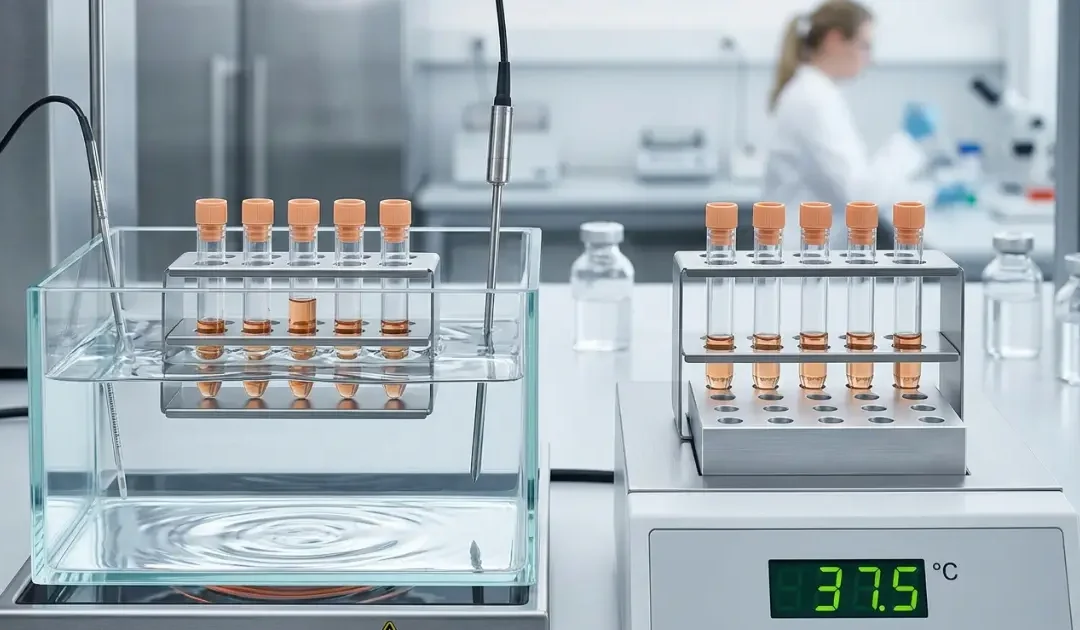
The choice between a water bath and a dry bath incubator is one of the most practical equipment decisions laboratories make, and it is one where the wrong choice for the application quietly creates problems that take time to trace back to the instrument. Both instruments provide controlled-temperature heating for laboratory samples. They do it through fundamentally different mechanisms, and those different mechanisms make each one appropriate for a different set of applications. Understanding the water bath vs. dry bath for laboratory comparison is the starting point for selecting the right instrument for your specific protocols.
This guide covers the heating principles, temperature capabilities, contamination considerations, maintenance requirements, and ideal applications of each instrument type.
How Each Instrument Heats Samples
A water bath fills a stainless steel or polycarbonate chamber with water, then heats the water to the set temperature using an electric element. Samples in tubes, flasks, or beakers are submerged or floated in the water, which transfers heat through direct contact and convection. Water’s high thermal capacity and good thermal conductivity produce gentle, even heating that distributes uniformly around the entire surface of the sample vessel. This even distribution makes water baths particularly suited for larger vessels and for applications requiring very uniform heating across all surfaces of the container.
A dry bath incubator, also known as a heat block, uses precision-machined aluminum blocks with wells that match specific tube formats. The block heats via a direct electrical element, and heat transfers from the block surface to the sample tube through direct conduction. According to Drawell Analytical’s technical comparison of dry baths and water baths, dry baths use solid aluminum blocks with precisely drilled wells to transfer heat directly to test tubes via conduction. This direct metal-to-tube contact produces faster temperature equilibration for small-format tubes than water bath heating and enables temperatures well above 100 degrees Celsius.
Temperature Range Comparison
Standard water baths are constrained by the boiling point of water, operating effectively up to approximately 99 degrees Celsius for most models. This covers the majority of biological and clinical applications that require temperatures up to 37, 56, or 95 degrees Celsius, but excludes protocols requiring temperatures at or above boiling. Some specialized applications use oil or silicone baths to extend the range, but these introduce different handling and safety considerations.
Dry bath incubators achieve a significantly wider temperature range, typically extending from ambient plus five degrees Celsius up to 130 degrees Celsius on standard models. This makes them appropriate for denaturation protocols at 95 to 100 degrees Celsius, sterilization steps requiring 121 degrees Celsius, and other applications where temperatures above the water boiling point are protocol requirements. In the water bath vs dry bath for laboratory comparison, the extended temperature range of dry baths is a meaningful advantage for molecular biology workflows.
Contamination Risk
A water bath maintains standing liquid at 37 degrees Celsius, which is the optimal temperature for microbial growth. Without consistent cleaning and monitoring, water baths develop biofilm, algae, and bacterial contamination that can affect sample integrity and contribute to surface contamination of the vessels placed in the bath. In labs working with PCR preparations, cell culture materials, or clinical samples where cross-contamination is a concern, water bath contamination management requires active attention.
Dry bath incubators eliminate this risk entirely. Without water, there is no standing liquid to support microbial growth, and no contamination transfer medium between sample vessels. Dry baths are the preferred heating instrument for molecular biology applications where PCR contamination is a concern and for clinical diagnostics where cross-sample contamination between tube exteriors must be minimized.
Maintenance Requirements
Water baths require regular draining and cleaning of the tank and heating elements to remove mineral scale and prevent microbial growth. Distilled or deionized water minimizes scale formation but must be replenished as it evaporates. Maintenance frequency increases with continuous-use scenarios.
Dry baths require cleaning of block wells when sample material spills or splashes, and periodic block cleaning to prevent buildup that affects heat transfer efficiency. Because they have no standing liquid, they have no evaporation to manage, no scale to address, and no microbial contamination risk. Maintenance burden is significantly lower.
Application Matching: Which to Choose
Choose a water bath for: Thawing frozen biological samples; incubating large-volume flasks or beakers; heating reagents in sealed bottles; serological and enzymatic testing requiring uniform heating across large vessel surfaces; applications where gentle, uniform temperature contact across the full vessel surface is important.
Choose a dry bath incubator for: PCR preparation and denaturation at 95 to 100 degrees Celsius; enzyme reactions in microtubes; blood serum analysis in small tube formats; any application requiring temperatures above 100 degrees Celsius; and any workflow where contamination prevention around sample vessels is a priority.
Making the Right Choice for Your Lab
The water bath vs. dry bath decision for the laboratory is ultimately resolved by your sample format, required temperature range, contamination sensitivity, and maintenance capacity. Many laboratories benefit from having both instruments, using each where it is best suited rather than trying to compromise with a single instrument that serves neither application optimally.
At NE LabSystems, we carry both water baths and dry bath incubators suited to clinical and research laboratory workflows, all backed by free extended warranties on U.S. purchases. Browse the full temperature control instrument range at NE LabSystems or call (877) 733-6838 to discuss the best fit for your protocols.