
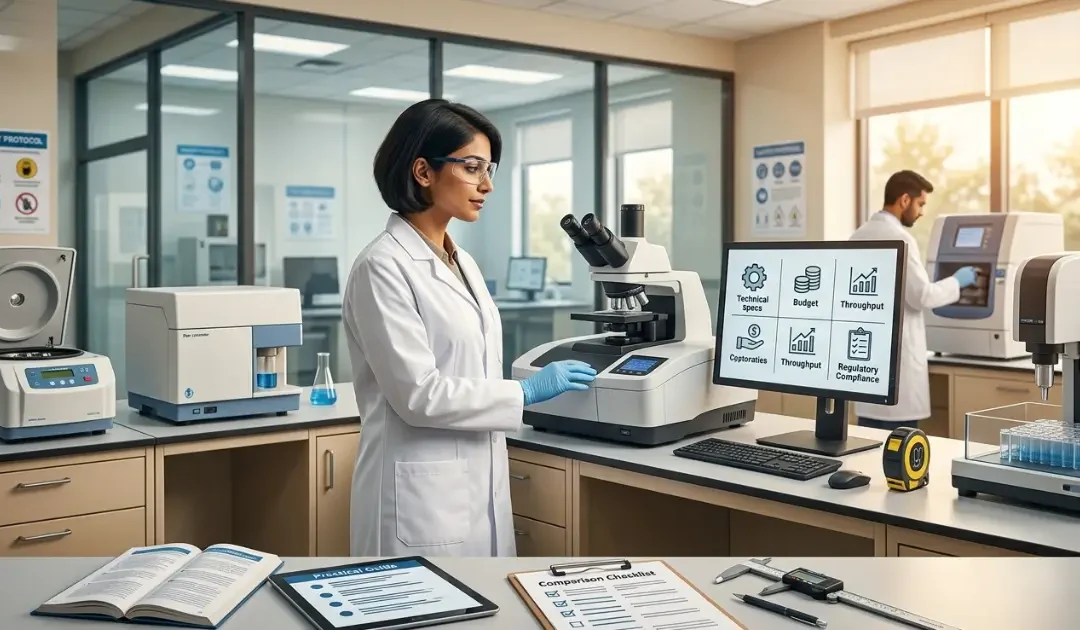
The wrong equipment choice for a research facility does not always announce itself dramatically. It shows up gradually: workflows that are slower than they should be because the instrument requires more manual intervention than anticipated, result variability that traces back to instrument performance limitations rather than biological variability, and escalating service costs as an instrument that was not matched to the workload is pushed beyond its designed use parameters. Choosing laboratory equipment for research facilities correctly requires a more systematic approach than scanning specification sheets and comparing prices.
This guide covers the key factors that determine whether a laboratory equipment investment delivers its intended value in a research environment.
Define Your Research Goals and Workflow First
The starting point for choosing laboratory equipment for research facilities is a clear definition of what the equipment must do for your specific research workflow, not a general assessment of what the equipment category is capable of. A centrifuge evaluation should begin with the samples you process, the separation requirements of your protocols, the volume and throughput your work demands, and the tube formats your experiments use. Evaluation against these specific requirements produces a much more relevant shortlist than evaluating against published specifications without reference to your actual workflow.
MSE Supplies’ equipment selection guidance notes that effective laboratory setup depends on fit-for-purpose performance, reliability, compliance with industry standards, and lifecycle considerations rather than maximum performance metrics. The instrument that matches your research requirements consistently outperforms a higher-specification instrument that exceeds your requirements and complexity tolerance.
Throughput and Capacity Requirements
Research facility throughput requirements vary enormously: a small molecular biology lab may process 20 samples per day, while a genomics core facility may process hundreds. Equipment capacity that comfortably exceeds your peak daily throughput, with headroom for growth, prevents the bottleneck that develops when an instrument is consistently operated at maximum capacity. Solvex Scientific’s equipment selection guide emphasizes that equipment suitable for analyzing twenty samples per day may be completely inadequate for a high-throughput facility processing hundreds.
Consider not just current throughput but projected growth over the instrument’s expected service life. An instrument sized for current volume that will need replacement in three years due to growth costs more over the long term than a slightly larger instrument purchased once.
Space, Infrastructure, and Compatibility
Physical space constraints, available utilities (power voltage, water connections, ventilation requirements), and compatibility with existing laboratory furniture and workflow layout all constrain equipment choices. A large floor-standing centrifuge may offer greater throughput but cannot be accommodated on a laboratory bench. A CO2 incubator requires both CO2 gas supply and appropriate ventilation. Evaluating these infrastructure requirements before purchase prevents the common problem of receiving equipment that cannot be installed without facility modifications.
Total Cost of Ownership
The purchase price of laboratory equipment is only the beginning of the cost calculation. Reagent and consumable costs, maintenance and service contract costs, calibration costs, staff training costs, and the cost of downtime associated with service events all contribute to total cost of ownership over the equipment’s service life. Theremi Group’s purchasing guidance notes that while the initial purchase cost matters, associated costs like upkeep, supplies, and service resources must be evaluated as part of the total investment.
A lower-priced instrument with expensive proprietary reagents, frequent service requirements, or significant staff training needs may cost substantially more over five years than a higher-priced instrument with open reagent compatibility, low maintenance demands, and straightforward operation.
Supplier Support and Service Infrastructure
The quality of post-purchase support from the supplier and manufacturer significantly affects the total ownership experience. Research facilities need responsive technical support when instruments malfunction, access to genuine replacement parts within reasonable lead times, and ongoing calibration support. Evaluating manufacturer and supplier reputation for service responsiveness before purchase, through industry references and conversations with existing users, is as important as evaluating the instrument’s technical specifications.
Warranty and Long-Term Reliability
Warranty coverage at purchase, and extended warranty options, directly affect the risk profile of any equipment investment. A comprehensive warranty that covers parts and labor for an extended period reduces the financial exposure of early component failures. When choosing laboratory equipment for research facilities, warranty terms should be evaluated as a component of the total cost calculation, not as an afterthought.
At NE LabSystems, every instrument we carry comes backed by free extended warranties on U.S. purchases and factory-trained engineering support from a team that understands what research facilities actually need from their equipment. Browse the full laboratory instrument catalog at NE LabSystems or call (877) 733-6838 to discuss the right instruments for your research facility’s specific requirements.