
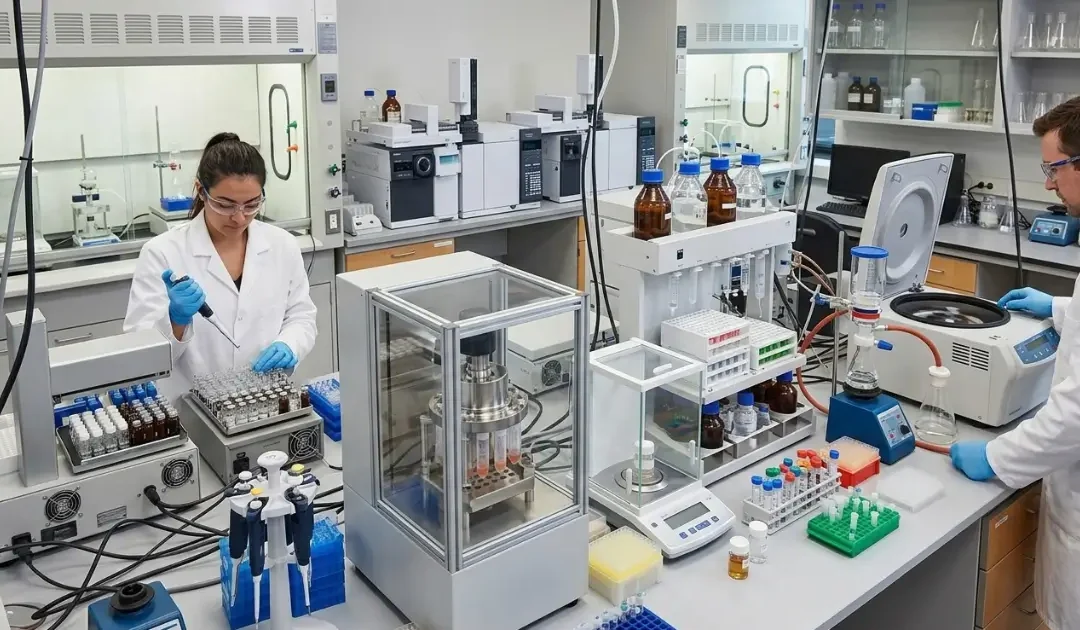
The accuracy of any laboratory analysis is ultimately limited by the quality of the sample preparation that precedes it. Even the most sensitive analytical instrument cannot compensate for a sample that was inadequately separated, improperly mixed, incorrectly heated, or contaminated during preparation. Laboratory sample preparation equipment is the category of instruments that converts raw biological, chemical, or environmental specimens into analysis-ready samples that produce reliable, reproducible results. Getting this category right is foundational to everything your lab produces.
This guide covers the essential sample preparation instruments that every modern laboratory needs, organized by function.
Centrifuges: The Core of Sample Separation
According to ScienceDirect’s review of centrifugal-assisted sample preparation in bioanalysis, the centrifuge is the most commonly used equipment in clinical research and practice for isolating cells and particles from liquid matrices during sample preparation. Clinical centrifuges, microcentrifuges, and high-speed models serve different volume ranges and force requirements, but all operate on the same sedimentation principle: centrifugal force separates mixture components by density, pelleting heavier particles while leaving lighter components in suspension.
Clinical diagnostic labs use clinical centrifuges to separate serum and plasma from whole blood before chemistry testing. Molecular biology labs use microcentrifuges for nucleic acid pelleting, protein precipitation, and small-volume separations. The selection of centrifuge type is driven by required g-force, sample volume, and tube format compatibility.
Vortex Mixers: Rapid Homogenization
Vortex mixers provide rapid, vigorous mixing of small-volume samples through eccentric motor-driven oscillation that creates a vortex inside the tube. They are essential laboratory sample preparation equipment for resuspending centrifuge pellets, dissolving dry reagents before use, homogenizing small-volume samples before aliquoting, and ensuring uniform distribution of components in master mixes and reagent preparations.
Multi-tube vortex models that process 24 to 50 samples simultaneously address throughput demands in high-volume preparation workflows, eliminating the sequential time cost and inter-sample timing variability of single-tube vortexing.
Water Baths and Dry Bath Incubators: Temperature-Controlled Incubation
Thermal incubation is a required step in many sample preparation workflows. Enzyme digestion, protein denaturation, nucleic acid denaturation before hybridization, sample thawing, and reagent warming all require controlled heating. Water baths provide uniform heating through direct water contact with sample vessels, making them suited for larger vessels and multiple simultaneous samples. Dry bath incubators use precision-machined metal blocks for rapid, precise conduction heating of small-volume tubes, making them the preferred instrument for molecular biology tube formats where contamination-free heating and extended temperature ranges above 100 degrees Celsius are required.
Rotator Mixers: Sustained Gentle Mixing
Not all mixing tasks benefit from vigorous agitation. Immunoprecipitation protocols require that antibody-bead complexes remain in continuous contact with target proteins in lysate over incubation periods of one to sixteen hours without the shear stress that vortexing would cause. Rotator mixers provide end-over-end rotation at 10 to 80 RPM, keeping samples uniformly mixed over extended periods without generating shear forces, bubble formation, or foam that could compromise sample integrity.
Homogenizers: Physical Disruption of Complex Samples
Some sample matrices cannot be processed by centrifugation or mixing alone because they contain intact tissue, cells embedded in extracellular matrix, or other physically complex structures that must be disrupted before analysis. Homogenizers provide mechanical disruption through bead beating, rotor-stator action, or ultrasonic energy that converts intact tissue samples into homogeneous suspensions suitable for downstream extraction and analysis.
Filtration Equipment: Removing Particulate Interference
Filtration removes particulate matter, cells, and debris that would interfere with downstream analytical measurements. Spin column filtration, syringe filtration, and vacuum filtration systems each serve specific sample types and volume ranges. In clinical diagnostics, filtration of plasma or urine samples removes cellular and protein particulates that would clog chromatography systems or produce optical interference in spectrophotometric assays. According to ScienceDirect’s bioanalysis review, filtration combined with centrifugation is among the most versatile approaches to laboratory sample preparation in clinical and research contexts.
Pipettes and Liquid Handling: Volumetric Precision
Every sample preparation workflow involves liquid transfers, and the accuracy and precision of those transfers directly affect downstream result quality. Variable-volume micropipettes covering the full range from sub-microliter to milliliter volumes are the most fundamental liquid handling instruments in any laboratory. Multichannel pipettes and electronic pipetting systems extend this capability to parallel transfer and serial dilution applications that would be impractical with single-channel instruments.
Building the Right Sample Preparation Setup
The laboratory sample preparation equipment your lab needs depends on the sample types you process, the analyses you perform downstream, and the volume and throughput your workflow demands. A clinical diagnostic lab processing blood and urine samples needs a different preparation instrument set than a molecular biology lab processing cell lysates or a pharmaceutical lab processing dissolution test samples.
At NE LabSystems, we carry the full range of sample preparation instruments, including centrifuges, vortex mixers, water baths, dry bath incubators, and rotator mixers suited to clinical and research laboratory needs. All are backed by free extended warranties on U.S. purchases. Browse the catalog at NE LabSystems or call (877) 733-6838 for a recommendation matched to your preparation workflow.