
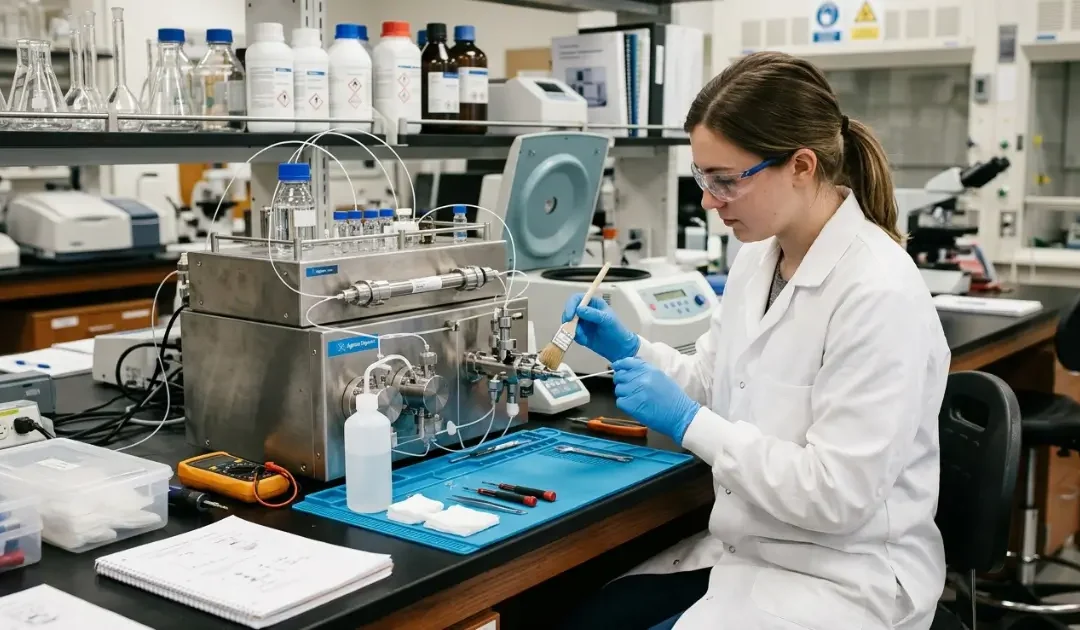
Laboratory instruments are precision tools. They produce the measurements that guide clinical decisions, validate research findings, and support regulatory submissions. When they are maintained properly, they do this reliably and consistently. When maintenance lapses, performance drifts in ways that are not always immediately visible: a centrifuge that no longer reaches its set speed, an incubator that runs two degrees high, a spectrophotometer whose lamp has degraded beyond its calibrated output. Understanding how to maintain laboratory equipment is therefore not an administrative task. It is a quality task that directly affects the scientific credibility of your laboratory output.
This guide covers the practical maintenance activities that keep laboratory instruments performing as intended, organized by the maintenance category and instrument type.
The Four Categories of Laboratory Equipment Maintenance
Lab Equipment Direct’s maintenance documentation describes four primary approaches to laboratory equipment maintenance. Preventive maintenance involves routine, scheduled tasks including cleaning, calibration, inspection, and part replacement. Calibration is the formal verification and adjustment of instrument measurement accuracy against traceable reference standards. Corrective maintenance addresses equipment issues as they arise following unexpected malfunctions. Predictive maintenance uses data and performance monitoring to anticipate failures before they occur. All four are components of a complete maintenance program, but preventive maintenance is the foundation that reduces the need for corrective responses.
Cleaning: The First Line of Defense
Most instrument performance problems have a cleaning-related root cause. Contaminated optical surfaces scatter light and produce erroneous absorbance readings. Biological material on centrifuge rotors and bowls accelerates corrosion and creates biohazard exposure risk. Scale accumulation on water bath heating elements reduces temperature control efficiency. Sample residue in dry bath block wells affects heat transfer.
The practical approach to cleaning is to make it routine, immediately after use rather than at the end of the week. Cleaning immediately after use prevents accumulation, reduces the force required to remove residue, and ensures that the instrument starts each run in a clean condition. Use cleaning agents compatible with the instrument materials: mild detergents and 70 percent ethanol for biological contamination on instrument surfaces, manufacturer-specified agents for specific instrument components.
Calibration Verification: Confirming Accuracy
Calibration verification confirms that an instrument is producing accurate measurements, that what it reports matches what is actually present. For regulated laboratory environments, the Clinical Laboratory Improvement Amendments (CLIA) regulation 42 CFR 493.1255 requires calibration verification to be performed at least every 6 months for all quantitative laboratory tests, according to CLIA compliance documentation from Oxmaint. The frequency requirement in unregulated settings depends on instrument criticality and usage: instruments used for quantitative measurements that drive decisions require more frequent verification than instruments used for qualitative screening applications.
How to Maintain Specific Laboratory Instruments
Centrifuges: Inspect the rotor before each use for cracks, corrosion, or deformation. Clean the rotor and bowl after each use. Verify speed accuracy quarterly against a calibrated tachometer. Test lid lock and safety interlock mechanisms regularly. Check for unusual vibration or noise during operation, which can indicate rotor imbalance or bearing wear.
Water baths: Drain and clean the tank regularly to remove mineral scale. Use distilled or deionized water to minimize scale formation. Verify temperature accuracy against a calibrated reference thermometer at the working position quarterly. Inspect the heating element for scale buildup that reduces efficiency. Check the lid seal to ensure minimal evaporation during runs.
Incubators: Clean interior surfaces regularly. Verify temperature accuracy quarterly. For CO2 incubators, calibrate the CO2 sensor monthly or per manufacturer schedule. Inspect door seals and gaskets for wear that allows heat and gas loss. Verify humidity control for CO2 incubators using a calibrated hygrometer.
Spectrophotometers and microplate readers: Monitor lamp performance and replace proactively before output degrades below specification. Verify wavelength accuracy using certified reference standards. Clean sample compartments and cuvette holders regularly. For regulated environments, perform photometric accuracy checks using certified neutral density filters or standard absorbing solutions.
Documentation: Making Maintenance Visible
Knowing how to maintain laboratory equipment also means knowing how to document that maintenance was performed. Maintenance logs recording the date, operator, task performed, and results of any verification measurements create the compliance evidence that regulatory auditors look for and the institutional record that enables trend analysis. Use LIMS, spreadsheets, or physical logs to maintain these records, and ensure they are stored in a location accessible to both operators and quality managers.
At NE LabSystems, every instrument we sell is backed by free extended warranties on U.S. purchases and factory-trained engineering support that helps labs maintain peak performance throughout the instrument’s service life. Browse the full catalog at NE LabSystems or call (877) 733-6838 to discuss maintenance support for your laboratory instruments.