
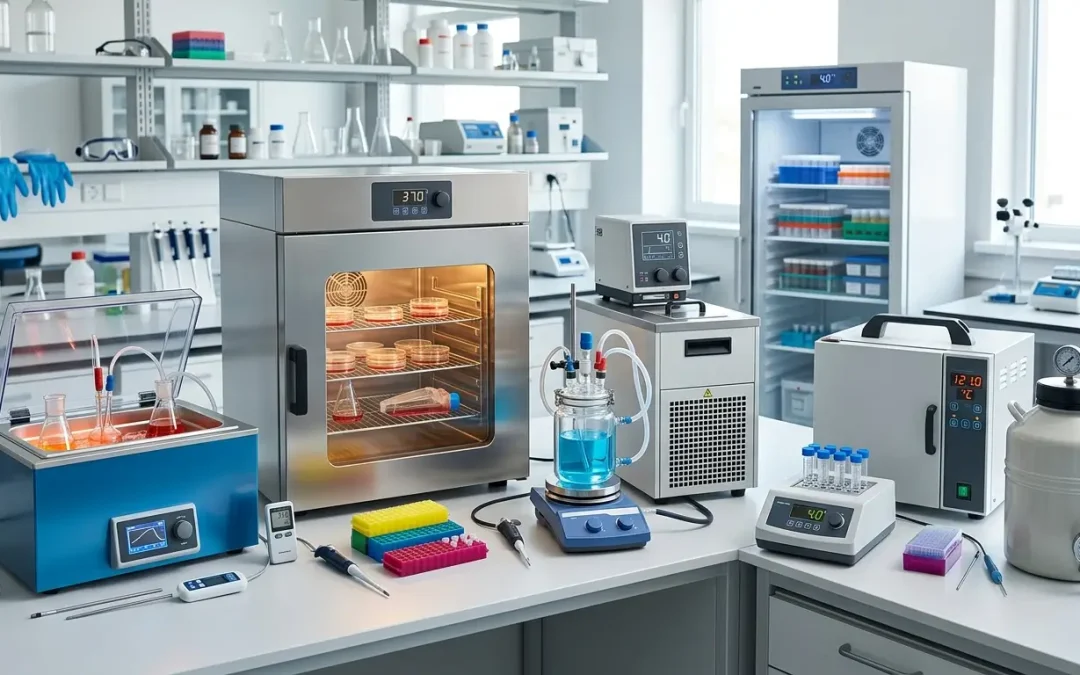
Temperature is a controlled variable in more laboratory protocols than any other single parameter. From the moment samples are received through every preparation, incubation, reaction, and storage step, temperature determines whether biological materials remain viable, whether chemical reactions proceed as designed, and whether measured values reflect the true state of the sample or an artifact of thermal deviation. Laboratory temperature control equipment is therefore not a single instrument category but a diverse set of instruments, each engineered for specific temperature ranges, stability requirements, and sample formats.
This guide covers the main types of laboratory temperature control equipment, their working principles, and how to match each to your application.
Water Baths: Uniform Liquid-Phase Heating
Water baths are among the oldest and most widely used forms of laboratory temperature control equipment. They maintain a volume of water at a set temperature and use that water to heat sample vessels through direct contact and convection. Their high thermal capacity provides excellent thermal buffering, and their uniform convective distribution of heat makes them suitable for applications requiring even heating of large or irregular vessel formats.
Standard water baths cover temperature ranges from ambient plus 5 degrees Celsius to 99 degrees Celsius. Circulating water baths add pump-driven fluid circulation that eliminates positional temperature gradients and provides uniform temperature across all sample positions simultaneously. Shaking water baths combine heating with orbital or reciprocating agitation for applications requiring both temperature control and mixing.
Dry Bath Incubators: Conduction-Based Precision Heating
Dry bath incubators use precision-machined aluminum blocks to transfer heat directly to sample tubes through conduction. This direct contact heating provides fast temperature equilibration for small-format tubes, reaches temperatures up to 130 degrees Celsius, and operates without the contamination risk associated with standing water. They are the preferred heating instrument for molecular biology tube formats: PCR preparation, enzyme reactions, and protein denaturation.
Refrigerators and Ultra-Low Temperature Freezers: Cold Storage Control
Cold storage equipment maintains biological samples, reagents, and sensitive materials at controlled low temperatures between sessions. Laboratory refrigerators at 2 to 8 degrees Celsius preserve reagents, enzyme stocks, and short-term biological samples. Minus-20 degree Celsius freezers store enzyme stocks, primers, and aliquots for weeks to months. Ultra-low temperature freezers at minus 80 degrees Celsius are required for long-term preservation of cell lines, biological specimens, and reagents where enzyme or nucleic acid stability must be maintained over months to years.
Incubators: Atmospheric Temperature Control
Laboratory incubators maintain controlled temperature environments in an enclosed chamber for biological culture and chemical incubation. General-purpose incubators operate from ambient plus 5 degrees Celsius to 70 degrees Celsius and support microbiological culture, biochemical studies, and environmental monitoring tests. CO2 incubators add control of CO2 concentration and relative humidity for mammalian cell culture. Shaking incubators combine temperature control with orbital agitation for aerobic bacterial culture and protein expression applications.
Heating Blocks and Thermocyclers
Thermal cyclers (PCR machines) are specialized temperature control instruments that precisely cycle samples through defined temperature profiles, repeatedly moving between denaturation, annealing, and extension temperatures to amplify specific DNA sequences. Gradient thermal cyclers add the capability to apply different annealing temperatures simultaneously across columns of the block, enabling temperature optimization experiments in a single run. Heating blocks serve as simplified dry incubators for fixed-temperature applications in molecular biology.
Circulators and Recirculating Chillers
Laboratory circulators pump temperature-controlled fluid either through an internal bath chamber or to an external jacketed vessel. Heated circulators cover from ambient plus 5 degrees Celsius to 150 degrees Celsius on most models. Refrigerated and heated circulators extend the range down to minus 40 degrees Celsius or lower, enabling precise temperature control through both cooling and heating phases in the same run. Recirculating chillers maintain laboratory instruments, spectrometers, and industrial processes at controlled temperatures below ambient through active refrigeration. These are among the most versatile laboratory temperature control equipment options for applications requiring both heating and cooling.
Selecting the Right Temperature Control Instrument
The primary selection criteria are the temperature range and stability your protocols require, the sample format (liquid bath, block incubator, or atmospheric chamber), whether CO2 or humidity control is needed, and whether the application requires agitation combined with temperature control. Once these parameters are defined, the appropriate instrument category becomes clear.
At NE LabSystems, we carry the full range of laboratory temperature control equipment including water baths, dry bath incubators, shaking incubators, and circulators suited to clinical and research laboratory applications. All are backed by free extended warranties on U.S. purchases. Browse the full temperature control range at NE LabSystems or call (877) 733-6838 for expert guidance.