
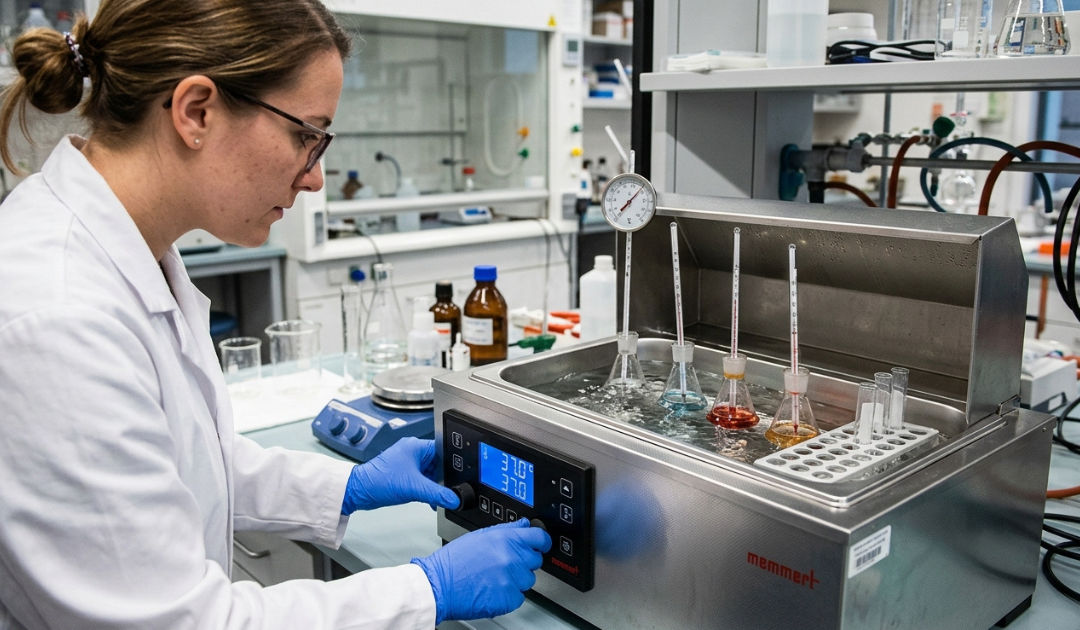
Temperature is the most critical parameter in most laboratory water bath applications. Whether you are thawing a frozen plasma sample, incubating an enzyme reaction, or maintaining a microbiological culture at growth temperature, the accuracy and stability of your bath temperature directly determine whether your results are reliable. Laboratory water bath temperature control is not just a feature on a specification sheet. It is the fundamental performance characteristic that makes the instrument useful or unreliable for precision laboratory work.
This guide covers the technology behind water bath temperature control, the specifications that matter, and how to maintain accuracy throughout the instrument’s service life.
The Temperature Control System: How It Works
Modern laboratory water baths use a PID (proportional-integral-derivative) controller to maintain temperature at the set point. A PID controller reads the current bath temperature from a sensor, calculates the difference between the current temperature and the set point, and adjusts the heater output in a way that minimizes that difference without overshooting or oscillating around the target. According to LW Scientific’s digital water bath technical documentation, PID technology provides accurate, stable temperature regulation that maintains consistent conditions for incubation, reagent warming, and thawing protocols. The result of effective laboratory water bath temperature control is a bath that reaches the set point smoothly and maintains it within a tight tolerance throughout the run.
Older water baths used simple on-off thermostats that heated until the temperature reached the set point, then stopped until it dropped below a threshold before heating again. This produced temperature oscillation around the set point rather than stable maintenance of it. PID-controlled baths avoid this oscillation, which is particularly important for applications like enzyme kinetics where even small temperature fluctuations affect reaction rates.
Temperature Stability vs Temperature Accuracy
These two specifications are often confused but measure different things. Temperature stability is how much the bath temperature fluctuates over time at a constant set point. Temperature accuracy is how closely the displayed temperature matches the actual temperature inside the bath. A bath can be stable but inaccurate (fluctuates minimally around the wrong temperature) or accurate but unstable (correct on average but oscillates widely). Both matter.
For critical applications, stability within plus or minus 0.1 to 0.3 degrees Celsius is the target for heated circulating baths, as published in Grant Instruments’ bath series specifications (stability of plus or minus 0.05 degrees Celsius for their T100 series). Accuracy should be verified against a NIST-traceable reference thermometer placed at the working position in the bath, not just at the sensor location.
Circulating vs Non-Circulating Temperature Distribution
Temperature uniformity across the bath chamber is a spatial performance characteristic that goes beyond point stability. In a non-circulating bath, the temperature at different positions can vary by one to three degrees Celsius depending on bath size and proximity to the heating element. This positional variation is invisible in results from a single sample but becomes a systematic error source when multiple samples are processed simultaneously, as each sample may be at a genuinely different temperature. Circulating water baths eliminate this by using a pump to continuously move bath fluid, distributing heat uniformly throughout the chamber. For laboratory water bath temperature control applications requiring simultaneous processing of multiple samples, a circulating model is the appropriate choice.
Verifying and Maintaining Temperature Accuracy
Temperature verification against a calibrated reference thermometer is a routine maintenance requirement for any water bath used in analytical work. The verification procedure involves placing a NIST-traceable reference thermometer at the working position in the bath, allowing the bath to equilibrate fully, and comparing the displayed temperature to the reference reading. The frequency of this verification depends on regulatory requirements and application criticality: monthly for regulated clinical environments, quarterly as a minimum for research applications.
Mineral scale accumulation on heating elements reduces heating efficiency over time and can cause temperature control instability. Regular draining and cleaning with appropriate descaling agents, followed by refilling with distilled water, maintains heater efficiency. Water level should be maintained above the minimum level indicated by the manufacturer to ensure that the temperature sensor is fully submerged and reading bath temperature rather than air temperature above the water line.
Digital Temperature Displays and Remote Monitoring
Modern laboratory water baths include digital temperature displays that provide a real-time reading of bath temperature separate from the set point. This dual display, showing both set point and actual temperature, allows operators to confirm that the bath has reached working temperature before adding samples. For regulated laboratory environments, data logging capability allows continuous recording of bath temperature throughout a run, creating documented evidence that temperature conditions were maintained as specified.
Maintaining Reliable Temperature Control
Reliable laboratory water bath temperature control depends on a combination of quality instrument engineering, regular calibration verification, consistent maintenance, and appropriate selection of circulating versus non-circulating models for each application.
At NE LabSystems, we carry a range of water baths with digital PID control, circulating and non-circulating configurations, and temperature ranges suited to clinical, research, and pharmaceutical laboratory applications. All are backed by free extended warranties on U.S. purchases. Browse the full water bath range or call (877) 733-6838 for a recommendation matched to your temperature control requirements.